
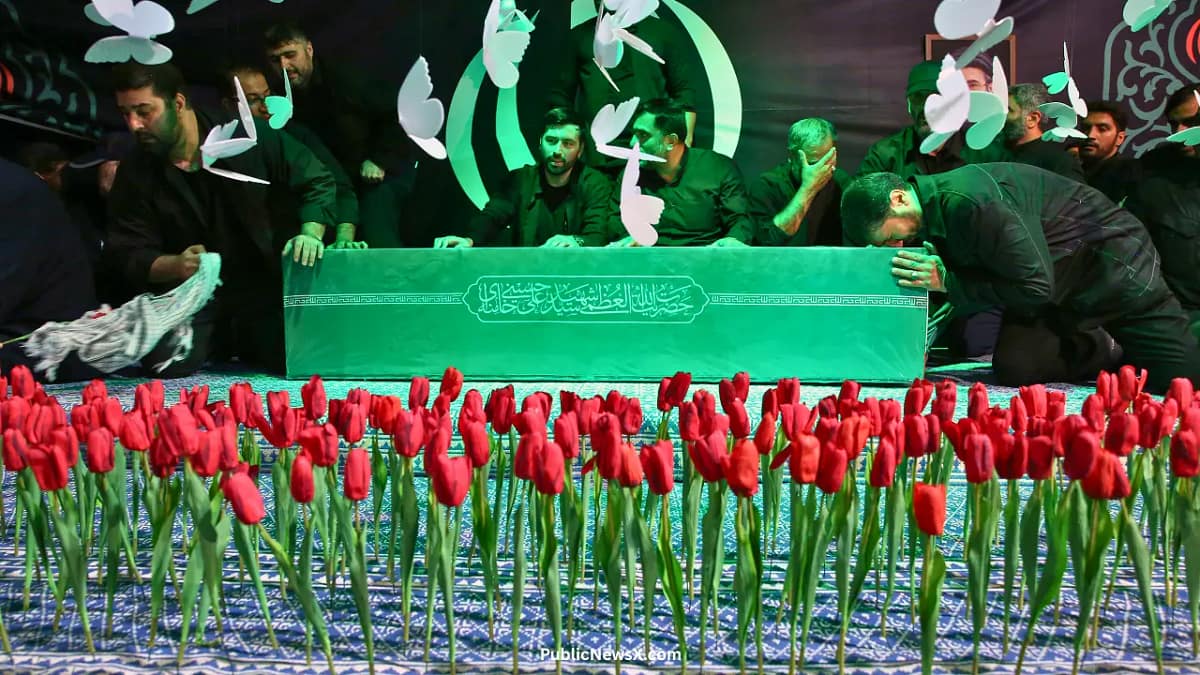
Tehran/ New Delhi: Iran on Friday began a week-long state funeral for slain Supreme Leader Ayatollah Ali Khamenei, with tens of thousands of mourners, senior clerics and foreign dignitaries gathering in Tehran for ceremonies that mark a defining moment in the country’s political transition following months of conflict.
Supreme leader Khamenei was killed on Feb. 28 in a joint U.S.-Israeli airstrike during the regional war, according to Iranian authorities and international reporting.
Funeral rites were postponed for more than four months as fighting continued before a fragile ceasefire created conditions for the ceremonies to proceed.
The funeral began at Tehran’s Grand Mosalla mosque, where Khamenei’s flag-draped coffin was placed for public mourning under heavy security.
Authorities have deployed large numbers of security personnel across the capital amid concerns over potential attacks and the possibility of renewed regional tensions.
Iranian officials said the funeral procession will continue through several important Shiite religious centers, including Qom, Najaf and Karbala in Iraq, before concluding with Khamenei’s burial at the Imam Reza Shrine in Mashhad.
State media have described the route as a tribute to both Khamenei’s leadership and Shiite traditions of martyrdom and resistance.
Authorities expect the ceremonies to draw millions of participants, although attendance figures cannot be independently verified.
The funeral also unfolds as Iran navigates a sensitive political transition following the appointment of Ayatollah Mojtaba Khamenei as the country’s new supreme leader.
Mojtaba Khameini, son of Supreme leader has not appeared publicly during the ceremonies.
International media, citing Iranian sources, reported that he remains out of public view because of injuries sustained during the February strike and security concerns.
Foreign delegations from several Asian and regional countries attended the opening ceremony.
Officials from Pakistan, China, Russia, Armenia, Tajikistan, Afghanistan and India were among those paying their respects.
The opening ceremony drew delegations from across the Global South.
India has sent an official delegation led by Minister of State for External Affairs Pabitra Margherita, accompanied by Bihar Governor Syed Ata Hasnain.
Pakistan was represented by Prime Minister Shehbaz Sharif and Army Chief Field Marshal Asim Munir, while senior officials from China, Russia, Armenia, Tajikistan and Afghanistan’s Taliban administration also attended the state funeral.
The funeral comes as indirect diplomatic efforts continue to preserve the ceasefire and prevent renewed hostilities between Iran, the United States and Israel.
Developing Story.
Share this content: