
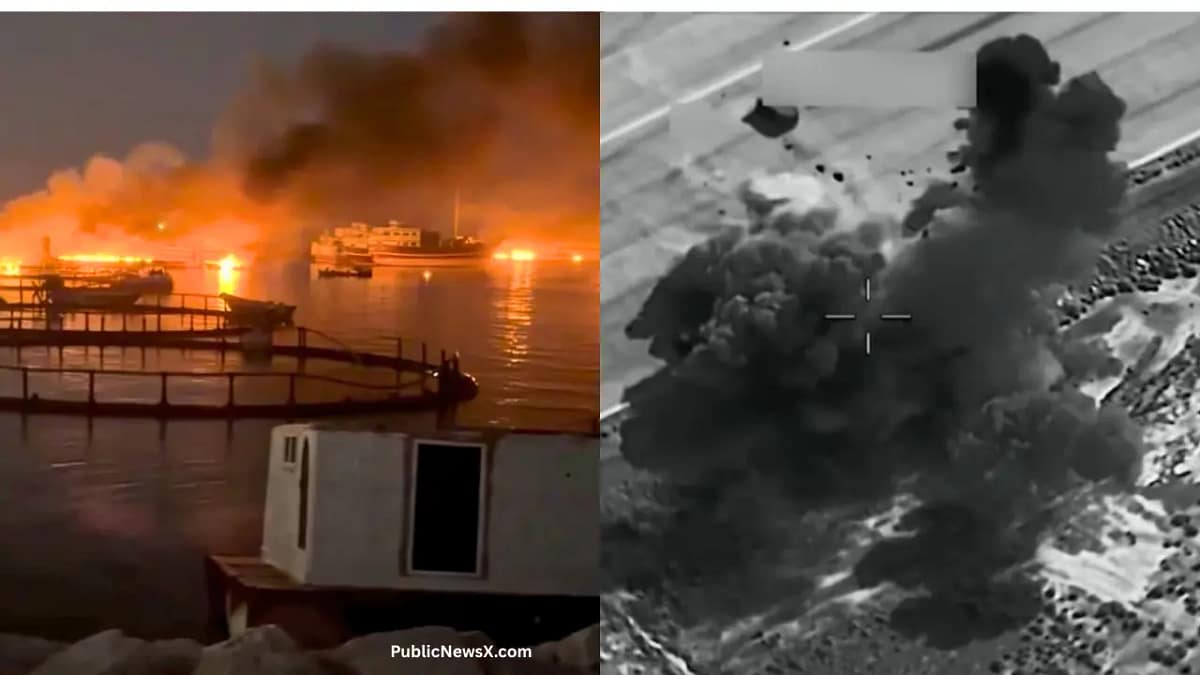
Washington/Tehran/ New Delhi: The United States earlier this week launched a new round of airstrikes against Iranian military targets, hitting around 90 military and maritime-related sites after accusing Tehran of attacking commercial shipping in the Strait of Hormuz.
The operation marked a sharp escalation following the collapse of a fragile ceasefire. While no fresh US strikes have been confirmed on Friday, tensions remain high as diplomatic contacts continue behind the scenes.
According to the US Central Command (CENTCOM), American forces carried out precision strikes against approximately 90 military targets aimed at degrading Iran’s capability to threaten international shipping through the Strait of Hormuz.
The military said the operation targeted air defence systems, coastal surveillance radars, anti-ship missile launchers, drone facilities, logistics hubs, maritime command-and-control centres and infrastructure linked to the Islamic Revolutionary Guard Corps (IRGC).
CENTCOM has not disclosed the exact locations of all the sites that were struck. However, Iranian state and local media reported explosions in Bandar Abbas, Qeshm Island, Minab and other parts of Hormozgan province, as well as in Bushehr province.
Iranian authorities have not released a comprehensive assessment of the damage, and independent verification of all reported strike locations remains unavailable.
Washington said the operation was launched after Iran allegedly targeted commercial vessels in the Strait of Hormuz, one of the world’s most important maritime trade routes that carries nearly one-fifth of global seaborne oil shipments.
US officials described the attacks as a major violation of the June ceasefire and said the strikes were intended to restore freedom of navigation and deter further threats to international shipping.
Iran responded by launching missile and drone attacks against US-linked military sites in the Gulf, according to regional reports. Tehran condemned the American operation as an act of aggression and warned that further military action would be met with additional retaliation.
US President Donald Trump declared the ceasefire effectively over and signalled there would be no immediate return to negotiations. His remarks reflected the growing deterioration in relations between Washington and Tehran following weeks of failed diplomatic efforts.
The renewed hostilities have kept global energy markets on edge. Oil prices rose on concerns that prolonged instability around the Strait of Hormuz could disrupt energy supplies and international shipping, although markets steadied later as no additional US strikes were reported on July 10.
Satellite imagery released by commercial providers reportedly showed visible damage at several military facilities, including craters, destroyed buildings and damaged naval infrastructure along Iran’s southern coast.
Experts said the images indicate significant damage to military assets, though the full extent of the strikes has not been independently confirmed.
Share this content: