
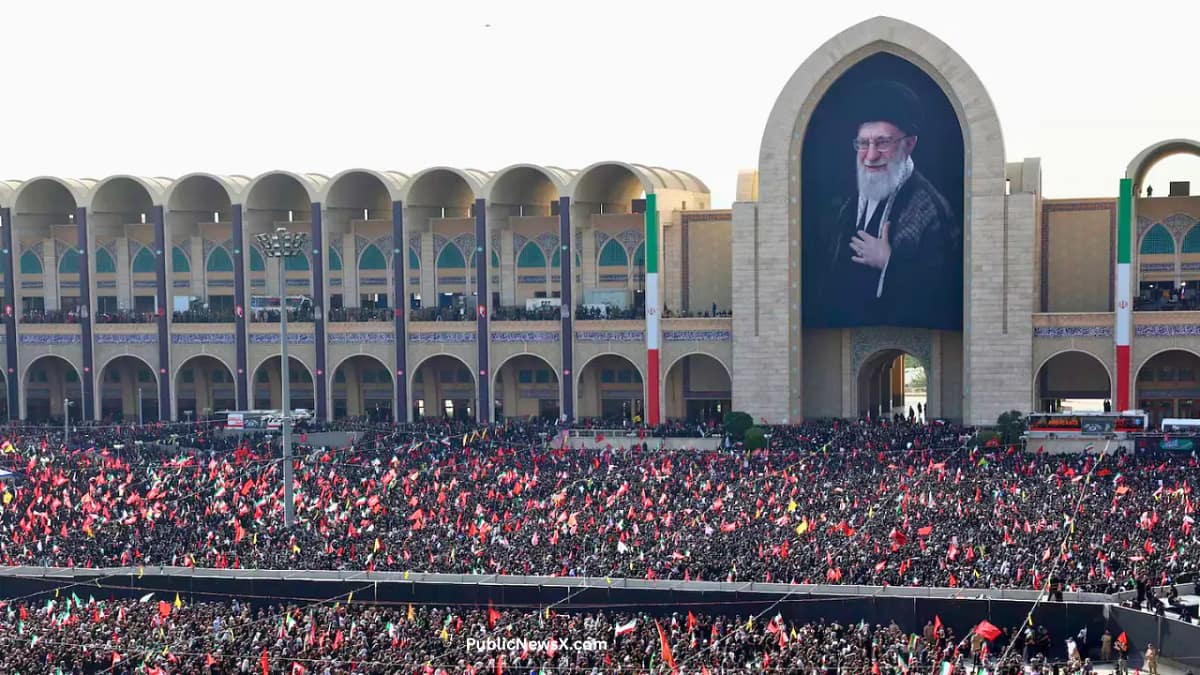
TEHRAN/WASHINGTON, July 4: Iran on Saturday launched six days of state funeral ceremonies for former Supreme Leader Ayatollah Ali Khamenei, with tens of thousands of mourners packing Tehran’s Grand Mosalla and chanting “Death to America” and “Death to Israel,” as U.S. President Donald Trump declared that the United States had “knocked the hell out of Iran” during the recent war and claimed Tehran was “dying to settle.”
The funeral, postponed for months because of the conflict, began more than four months after Khamenei was killed in a joint U.S.-Israeli airstrike on February 28 that triggered the 2026 Iran war. The week-long ceremonies will continue across Tehran, Qom, Karbala, Najaf and other cities before concluding with his burial in Mashhad on July 9, with Iranian authorities expecting millions of mourners.
Mourners dressed in black carried Iranian flags, portraits of Khamenei and red banners symbolising martyrdom. Several participants displayed placards reading ”#KillTrump”, while loudspeakers led crowds in chants against the United States and Israel, slogans that have remained central to Iran’s official political rhetoric since the 1979 Islamic Revolution.
The funeral coincided with the United States’ 250th Independence Day celebrations. Speaking at Mount Rushmore, Trump said: “We knocked the hell out of Iran. They’re dying to settle. They want to settle so badly. We gave them a week off for a funeral because we’re nice.” He suggested negotiations with Tehran could resume after the mourning period ends.
Trump’s remarks came as diplomatic contacts between Washington and Tehran remain paused following the conflict. According to reports, mediators have indicated discussions over Iran’s nuclear programme and regional security could restart after the funeral ceremonies conclude.
Iranian officials did not immediately respond to Trump’s latest comments. However, Tehran has consistently rejected U.S. claims that military pressure forced it toward negotiations. Foreign Minister Abbas Araghchi has maintained that Iran remains “ready for dignified diplomacy” while also prepared to defend itself against any future military action.
State television portrayed the funeral as a demonstration of national unity and defiance following the war, with authorities presenting the massive turnout as proof that the Islamic Republic remains resilient despite losing the leader who ruled Iran for nearly four decades. At the same time, analysts note that the ceremonies also serve as a political show of strength as Iran enters a new leadership era under Supreme Leader Mojtaba Khamenei following months of conflict and internal uncertainty.
The ceremonies have prompted extensive security measures across Tehran, including road closures, restrictions around the Grand Mosalla complex and crowd-control warnings after officials urged mourners to avoid crush incidents during what is expected to be one of the largest public gatherings in Iran since the funeral of military commander Qassem Soleimani in 2020.
Share this content: