
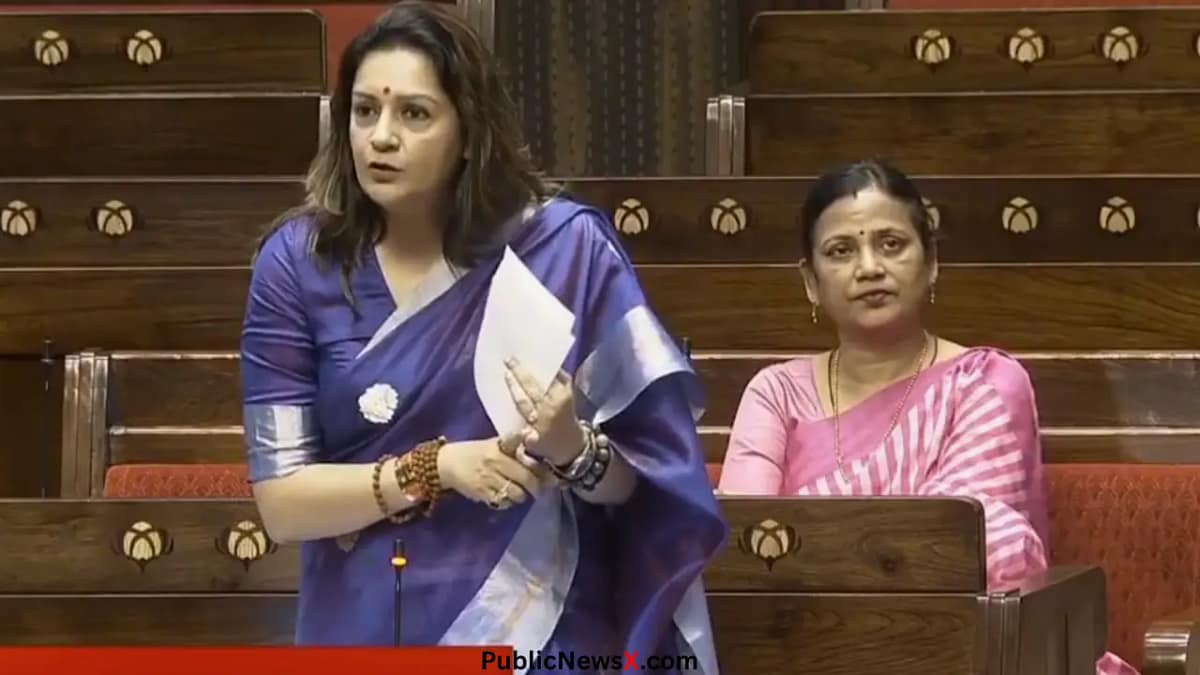
New Delhi: Rajya Sabha MP Priyanka Chaturvedi on Friday used Zero Hour in Parliament to mount a sharp attack on what she described as “judicial overreach,” linking the issue to the recent controversy over an NCERT Class 8 chapter that discussed corruption within the judiciary and to a Supreme Court order that reportedly sidelined several academics from publicly funded roles.
Chaturvedi questioned the implications of the court’s direction after the controversy surrounding a social science textbook published by the National Council of Educational Research and Training. The book contained a chapter discussing the functioning of courts, including issues such as corruption allegations, delays in justice delivery and the heavy backlog of cases across India’s judicial system.
The chapter triggered legal scrutiny and eventually led to intervention by the Supreme Court of India. Reports said the court expressed strong concern over the portrayal of the judiciary and directed authorities to distance certain academics associated with the chapter from publicly funded curriculum work.
Among those affected was historian Michel Danino, along with two other experts who had been linked to the textbook project.
Speaking in the Rajya Sabha, Chaturvedi framed the development as a broader institutional question rather than a narrow curriculum dispute.
“The concern is not just about a textbook chapter,” she said, according to parliamentary accounts of the intervention. “The concern is whether institutions are crossing constitutional boundaries and whether academic voices can be excluded from public work because they raised uncomfortable realities.”
Her remarks brought into focus a deeper tension in India’s institutional framework: how to balance respect for the judiciary with the democratic principle that public institutions, including courts, remain open to scrutiny and debate.
The NCERT chapter at the center of the controversy had attempted to introduce students to the functioning of courts and the challenges they face. Among the topics discussed were corruption allegations against judges, the slow pace of trials, and the structural pressures created by millions of pending cases across different levels of the judiciary.
Such themes are not new in public discourse. India’s judicial system has repeatedly confronted questions about transparency and accountability. Critics of the court’s intervention argue that discussing these issues in textbooks reflects widely documented realities rather than an attempt to undermine the judiciary.
Chaturvedi’s intervention also comes against the backdrop of past controversies that have fueled debate about accountability within the judicial system.
One such episode involved allegations surrounding large quantities of cash reportedly discovered and destroyed at the residence of a sitting judge, an incident that sparked intense discussion in legal and political circles about oversight mechanisms and internal disciplinary processes within the judiciary.
For critics of the court’s recent directive, that episode underscores the importance of acknowledging institutional weaknesses rather than suppressing discussion about them.
Supporters of stronger judicial oversight, however, argue that the dignity and credibility of courts must be protected, particularly in educational material meant for school students. They say references to corruption in textbooks risk eroding public trust in the justice system.
The dispute therefore goes beyond a single chapter or a single order. At stake is the broader question of whether the judiciary should intervene directly in academic content and whether such intervention could affect academic independence.
Chaturvedi’s remarks have placed that question squarely in the political arena. By raising the issue in Parliament, she effectively turned a textbook controversy into a debate about institutional boundaries.
Her argument centers on a constitutional principle: that the separation of powers requires each institution to operate within its domain. In that framework, education policy and curriculum design traditionally fall within the purview of academic bodies and the executive rather than the judiciary.
Legal scholars note that the Indian Constitution does not shield any institution from criticism or analysis. Academic discussions about governance institutions, including the judiciary, are common in universities and public discourse. The question raised by the current controversy is whether similar discussions should appear in school textbooks.
The NCERT has already withdrawn the disputed Class 8 book and issued an apology, saying the content would be reviewed and revised before any future publication.
Yet the larger debate triggered by the episode is unlikely to fade quickly. For many observers, the controversy now sits at the intersection of three sensitive issues: academic freedom, judicial authority and public trust in institutions.
By placing the issue before Parliament, Chaturvedi has amplified that debate, asking whether confronting uncomfortable truths about institutions strengthens democracy or undermines it.
Share this content: