
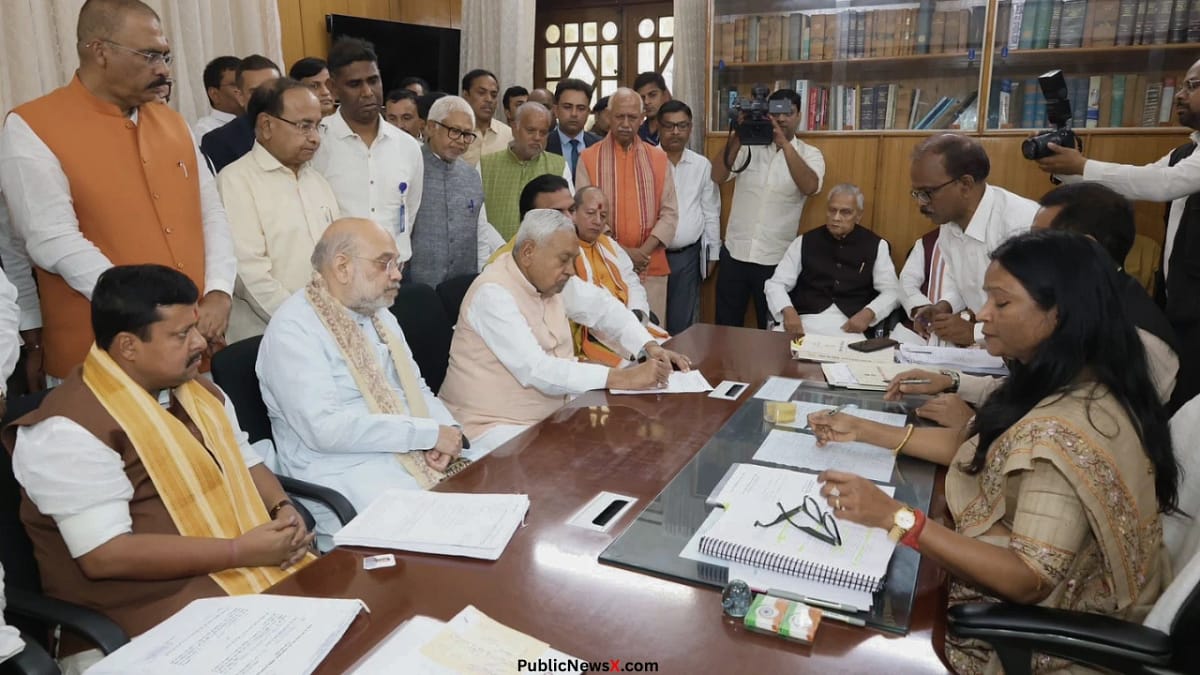
Patna/New Delhi: The Rajya Sabha election in Bihar turns unexpectedly competitive. Five seats are open this year. Six candidates file nominations. Voting will now take place on March 16, 2026
Five candidates belong to the ruling alliance. One candidate represents the opposition. The ruling bloc includes the Bharatiya Janata Party and the Janata Dal (United).
The candidates from the ruling alliance include Nitish Kumar, Nitin Nabin, Shivesh Kumar Ram, Ramnath Thakur, and Upendra Kushwaha.
The opposition fields Amarendra Dhari Singh from the Rashtriya Janata Dal (RJD).
The numbers explain the tension. Bihar has 243 MLAs in the Assembly. A candidate needs about 41 votes to win one seat. The ruling alliance controls roughly 202 MLAs. It can easily secure four seats.
The fifth seat creates uncertainty. The ruling bloc needs a few additional votes. That gap makes smaller parties suddenly important. Even a handful of MLAs can decide the result.
Attention now turns to the All India Majlis-e-Ittehadul Muslimeen. The party holds five MLAs in the Bihar Assembly and their votes can influence the final seat.
If AIMIM backs the opposition, the contest tightens. The opposition could block the ruling alliance’s fifth seat. If AIMIM abstains or votes differently, the ruling bloc benefits.
This gives AIMIM unusual leverage in the election. The party can signal political independence. It can also reshape the narrative of Muslim political representation in Bihar.
Another dimension complicates the story. Political observers recall tactical cooperation between AIMIM and the Bharatiya Janata Party in local politics in Maharashtra. Municipal alliances have occurred before.
Such precedents fuel speculation. Some analysts describe these moves as transactional politics. Parties sometimes cooperate locally despite national rivalry.
The Bihar vote therefore raises broader questions. Will ideological alliances hold firm? Or will tactical choices decide the final seat?
The election also carries implications for Nitish Kumar. His move to the Rajya Sabha signals a political transition. It may mark a gradual shift from state leadership.
For years, Nitish Kumar shaped Bihar’s political landscape. His entry into the Upper House could change that equation. A new leadership phase may begin in the state.
The Rajya Sabha election therefore becomes more than a routine vote. It tests alliance discipline. It highlights the influence of smaller parties.
Most importantly, it shows how a few MLAs can reshape outcomes. India’s Upper House elections increasingly reflect coalition politics. Bihar may be the latest example.
Share this content: