
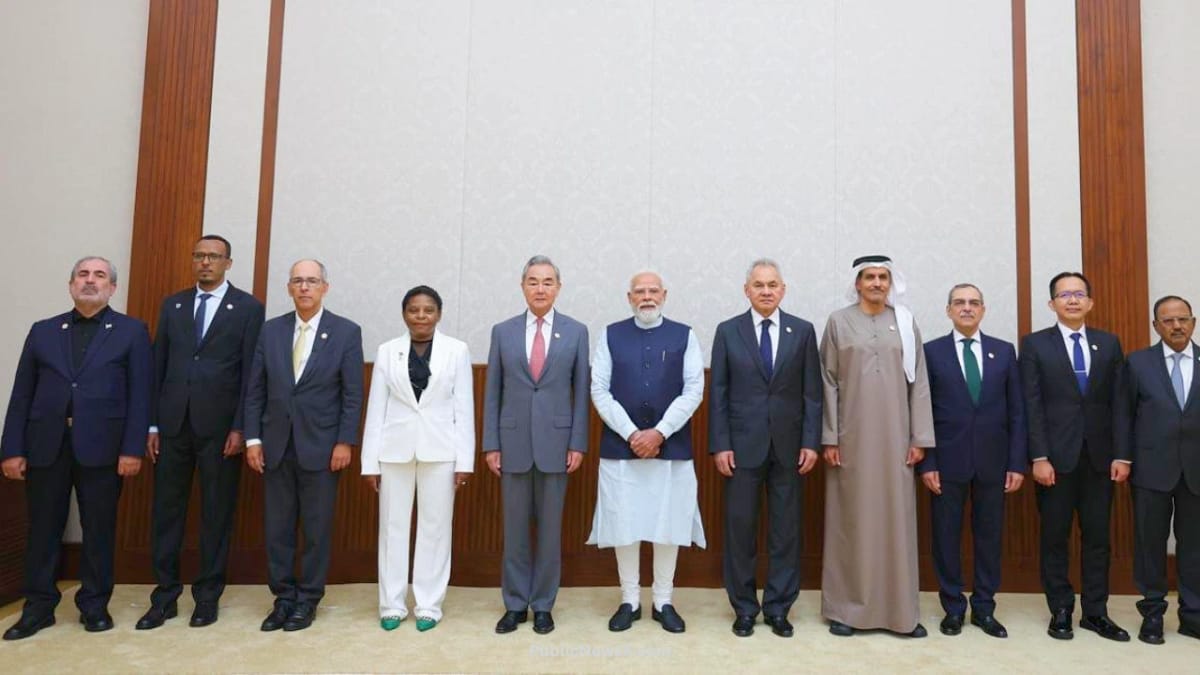
New Delhi: India deepens security engagement with BRICS nations while simultaneously advancing a major trade framework with the United States. New Delhi appears to be navigating one of the most complex phases of its foreign policy.
The latest meeting of National Security Advisors and senior security officials of BRICS countries in India comes at a time when India-US economic ties are being projected toward a possible $500 billion trade target over the next five years, even as geopolitical tensions from the Middle East continue to reshape global alignments.
The timing raises an uncomfortable question: Is India building a stronger strategic hedge through BRICS while keeping Washington as its primary economic partner, or is New Delhi simply expanding its options in an increasingly uncertain world ?
The answer lies in India’s long-standing approach of strategic autonomy. Over the past decade, New Delhi has significantly strengthened defence, technology and trade cooperation with the United States.
The proposed trade expansion reflects India’s ambition to become a major manufacturing and supply chain hub, attracting investment from American companies seeking alternatives in a changing global economy.
At the same time, the recent Hormuz crisis has exposed the risks of depending on any single geopolitical bloc.
Energy security, maritime routes and regional stability remain critical concerns for India, whose economy relies heavily on uninterrupted global trade flows. While tensions involving major powers have increased pressure on countries to choose sides, New Delhi has largely avoided direct confrontation and continued diplomatic engagement across competing platforms.
This explains the significance of BRICS from India’s perspective. For New Delhi, the grouping is not necessarily an alternative to Western partnerships but a platform to amplify the voice of developing economies, push for reforms in global institutions and ensure that emerging powers have a larger role in shaping international security discussions.
India’s message appears consistent: economic cooperation with the United States can expand, but foreign policy decisions will not be outsourced. The BRICS security dialogue reflects an attempt to create additional diplomatic space at a time when global rivalries are becoming sharper.
The challenge before New Delhi is whether this balance can survive.
Can India continue pursuing a historic trade partnership with Washington while maintaining its leadership role in BRICS and protecting its strategic autonomy when global crises test every relationship?
Share this content: