
New Delhi: Barely eleven days after the US and Iran signed a MoU intended to halt their direct hostilities.
On 25 June, 2026, Iran launched attacks on commercial vessels in the Strait of Hormuz. Tehran justified the strikes by insisting that Israel had failed to withdraw from Lebanon, a core element of the broader regional de-escalation package.
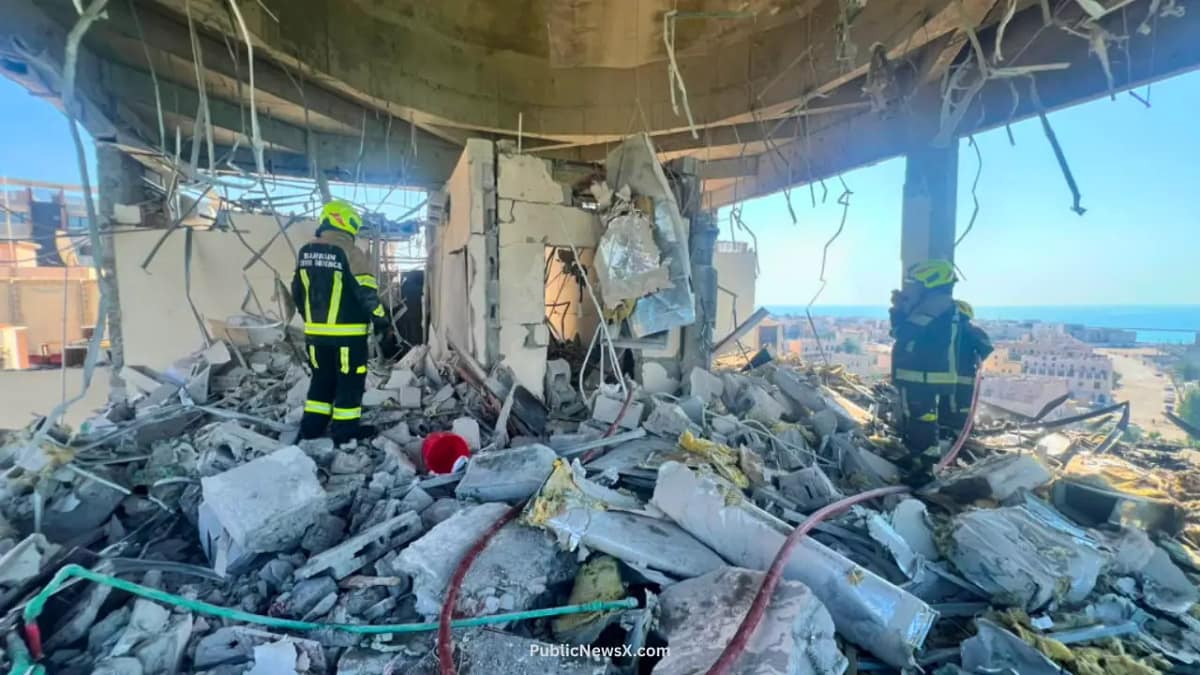
This chain of events has now produced fresh US retaliatory airstrikes on Iranian targets and Iranian missile and drone responses against US-linked sites in Bahrain and Kuwait, raising urgent questions about whether any party truly possesses the strategic autonomy to enforce peace.
The paradox is evident to any observer who has followed this conflict.
The June 17 agreement, signed personally by President Donald Trump and Iranian President Masoud Pezeshkian, was never merely a bilateral truce.
It sought to reopen the Strait of Hormuz to unrestricted shipping, ease certain sanctions, and establish a 60-day framework for nuclear discussions.
Critically, it also required parallel steps on the Israel-Lebanon front, including an Israeli withdrawal from areas Iran and its allies considered occupied.
Iranian Foreign Ministry spokesperson Esmaeil Baghaei made this linkage explicit on Sunday. He stated that the United States bore responsibility for pressing Israel to cease attacks on Lebanon and withdraw fully. Such measures, he said, represented a necessary condition for any final and lasting regional agreement. Iran, he added, seeks an immediate timetable for unconditional Israeli withdrawal from Lebanese territory.
From Tehran’s perspective, the sequence is clear. Israel’s continued operations in Lebanon constitute a breach of the understanding.
When Washington did not compel its ally to comply, Iran felt justified in resuming pressure on maritime traffic through the strait. In this narrative, Iran did not break the deal first. It responded to perceived bad faith. Yet the United States sees the matter differently. After Iranian strikes on commercial shipping, including a vessel carrying millions of barrels of crude, President Trump authorized targeted US airstrikes on Iranian missile storage, drone facilities, coastal radar sites, and related infrastructure. Central Command described these actions as necessary self-defense and enforcement of the agreement.
Iran’s Revolutionary Guard Corps replied by striking sites associated with US forces in Bahrain and Kuwait, claiming precise hits while Gulf states reported interceptions and condemned the aggression.
This cycle exposes deeper structural tensions. The United States has demonstrated a desire for strategic autonomy, seeking a way out of open-ended Middle East commitments without abandoning core interests in freedom of navigation and ally protection.
Earlier in the year, Washington joined Israel in significant strikes against Iranian assets.
Now, after months of costly engagement, the administration appears ready to pivot toward managed de-escalation and diplomatic off-ramps. Yet Israeli Prime Minister Benjamin Netanyahu’s government shows little inclination to ease pressure on Lebanon or Hezbollah.
This dynamic places Washington in a difficult position. It cannot easily dictate terms to a close partner, yet failure to do so risks unraveling agreements negotiated at considerable effort. The result is a conflict that may persist in cycles of strike and counterstrike, with each side blaming the other for bad faith.
Ceasefires in this region have often served as breathing spaces rather than turning points.
The April pause that preceded the June memorandum followed intense fighting that began in late February with major US-Israeli operations against Iranian leadership and military targets. Iran retaliated across multiple fronts, including against Gulf bases and Israel itself.
Fatigue on all sides produced the recent deal, but implementation exposed unresolved contradictions, particularly around Lebanon. Iran views Hezbollah as a strategic red line. Israel sees the group as an existential threat that must be neutralized regardless of broader diplomatic timelines.
The United States finds itself caught between these irreconcilable positions, its strategic autonomy constrained by alliance realities.
Regional reactions add further complexity. Bahrain and Kuwait, hosts to important US facilities, denounced Iranian strikes as heinous violations of sovereignty. European capitals, already strained by record heat, worry about energy price spikes. Global markets remain on edge.
China and Russia have called for restraint while protecting their own interests in stable oil flows.
For ordinary citizens across the Middle East, the human cost continues to mount through displacement, economic hardship, and the ever-present risk of miscalculation.
Maturity in statecraft requires acknowledging uncomfortable truths. Iran bears responsibility for actions that directly threaten international shipping lanes. The United States cannot ignore such provocations without undermining its credibility as a guarantor of global commons. At the same time, Washington’s ability to deliver on broader commitments, including pressure on Israel regarding Lebanon, is limited by political realities in Jerusalem.
Netanyahu’s approach appears designed to keep the United States engaged rather than aloof, ensuring American resources remain available for Israeli security priorities.
This alignment of interests may suit Israel but complicates American efforts to wind down direct involvement.
The current exchanges, though limited so far with no major confirmed casualties, test whether the memorandum can be salvaged. Diplomatic channels have not fully closed.
Mediators in Pakistan, Oman, and elsewhere retain faint opportunities to bridge gaps. Success would require Tehran to demonstrate verifiable restraint on shipping, Washington to exert credible influence on Israeli actions in Lebanon, and all parties to accept imperfect compromises on timelines and verification.
History offers important lessons. Previous nuclear and regional deals collapsed under layers of distrust. Yet the speed of the latest breakdown also signals exhaustion. Leaders on all sides understand the costs of endless escalation.
The Strait of Hormuz carries roughly one-fifth of global oil trade. Prolonged disruption would harm economies far beyond the region. For populations already weary of conflict, another cycle serves no one.
As this story develops, the central question remains whether any actor can exercise genuine strategic autonomy ?
Iran insists on linking Lebanon to Hormuz. Israel prioritizes its northern security. The United States seeks an exit ramp that preserves influence without open-ended war.
Bridging these positions will demand patience, leverage, and realism.
Without these efforts, the shaky truce could completely collapse. That would drag out a war that has already caused far too much suffering and damage.
Can the United States, Iran, and Israel find the will to break this dangerous cycle before it claims even more lives ?
Share this content: