
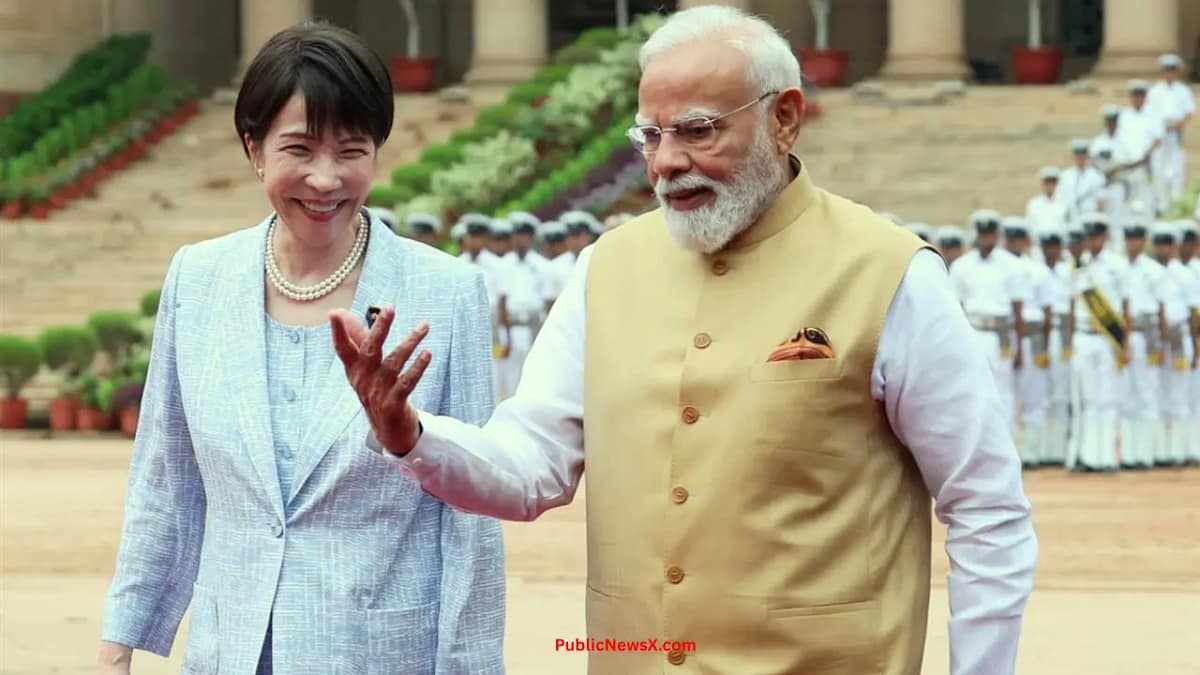
New Delhi, July 2: Prime Minister Narendra Modi referred to Japanese Prime Minister Sanae Takaichi as his “younger sister” during the joint press statement.
Responding with a smile, Takaichi said, “You called me a beautiful younger sister… we confirmed that we are on the same page and will nurture this relationship as brother and sister,” underscoring the close personal rapport and the growing strategic partnership between India and Japan.
Japan’s newly elected Prime Minister Sanae Takaichi on Thursday paid her first official visit to India, with New Delhi and Tokyo announcing a wide-ranging set of initiatives to deepen cooperation in defence, artificial intelligence (AI), economic security, clean energy, healthcare and investment.
Welcoming Prime Minister Takaichi at the annual India-Japan Summit, Prime Minister Narendra Modi described the visit as the beginning of “a new chapter” in the India-Japan Special Strategic and Global Partnership, saying that mutual trust had become the two countries’ greatest strategic asset amid growing global uncertainty.
Modi noted that Takaichi is Japan’s first woman Prime Minister and recalled the shared Buddhist heritage linking India’s civilisational ties with Japan’s Nara Prefecture. He also highlighted Japan’s longstanding contribution to India’s economic growth, particularly through investments in sectors such as automobiles and electronics.
Reaffirming their shared commitment to a free, open, prosperous and rules-based Indo-Pacific, the two leaders agreed to strengthen cooperation across strategic, economic and technological domains. Modi said the initiatives announced during the summit would contribute to regional peace, stability and prosperity.
Technology emerged as a key pillar of the summit. India and Japan issued a Joint Statement on Artificial Intelligence, while several organisations from India’s AI ecosystem signed agreements with Japanese partners. Modi said Japan’s expertise in precision technology and India’s software capabilities would together accelerate global AI innovation.
In a significant step in defence cooperation, the two countries signed their first defence co-development agreement, launching a joint project to develop a Naval Radio Antenna. According to Modi, the project marks the beginning of bilateral defence technology co-development and will contribute to regional peace, maritime security and a rules-based order.
Economic cooperation also received a major boost. Modi said that more than 100 new business agreements concluded over the past year are expected to bring more than US$10 billion in Japanese investment into India.
The two countries also signed an agreement between their financial services agencies to facilitate smoother capital and investment flows.
Setting an ambitious long-term objective, the two leaders agreed to work towards attracting 10 trillion yen in Japanese investment into India over the next decade while also aiming to double the number of Japanese companies operating in the country. Modi said India’s continuing economic reforms and improving ease of doing business would create greater opportunities for Japanese investors.
Recognising the growing importance of resilient supply chains, India and Japan also agreed on a Joint Roadmap on Economic Security, focusing on strategic sectors such as semiconductors, quantum technologies and advanced materials to strengthen supply chain resilience.
Energy security and clean energy transition featured prominently in the discussions. Under the newly announced India-Japan Bio-gas Initiative, Japan will support the establishment of 1,000 biogas and organic fertiliser plants in India, complementing the country’s GOBARdhan initiative and supporting sustainable rural development. The two sides also agreed to expand cooperation in battery technologies, green hydrogen, nuclear energy and energy resilience.
The leaders further announced agreements in pharmaceuticals, medical devices and biotechnology, with the objective of combining India’s manufacturing scale and Japan’s technological strengths to contribute to global health security.
A new India-Japan Next Generation Mobility Partnership Framework will expand bilateral industrial cooperation beyond the automotive sector into shipbuilding, aviation and logistics.
The two countries also agreed to strengthen people-to-people ties by expanding talent mobility, skill development, technical internship programmes, research collaboration, higher education partnerships and startup cooperation.
Looking ahead, India and Japan will celebrate the 75th anniversary of diplomatic relations next year, with both governments planning to expand cooperation in culture, tourism and the creative economy.
Concluding the summit, PM Modi expressed confidence that the deep trust underpinning India-Japan relations would help realise the shared vision of a developed India, a stronger Japan and a more prosperous Indo-Pacific.
Share this content: