
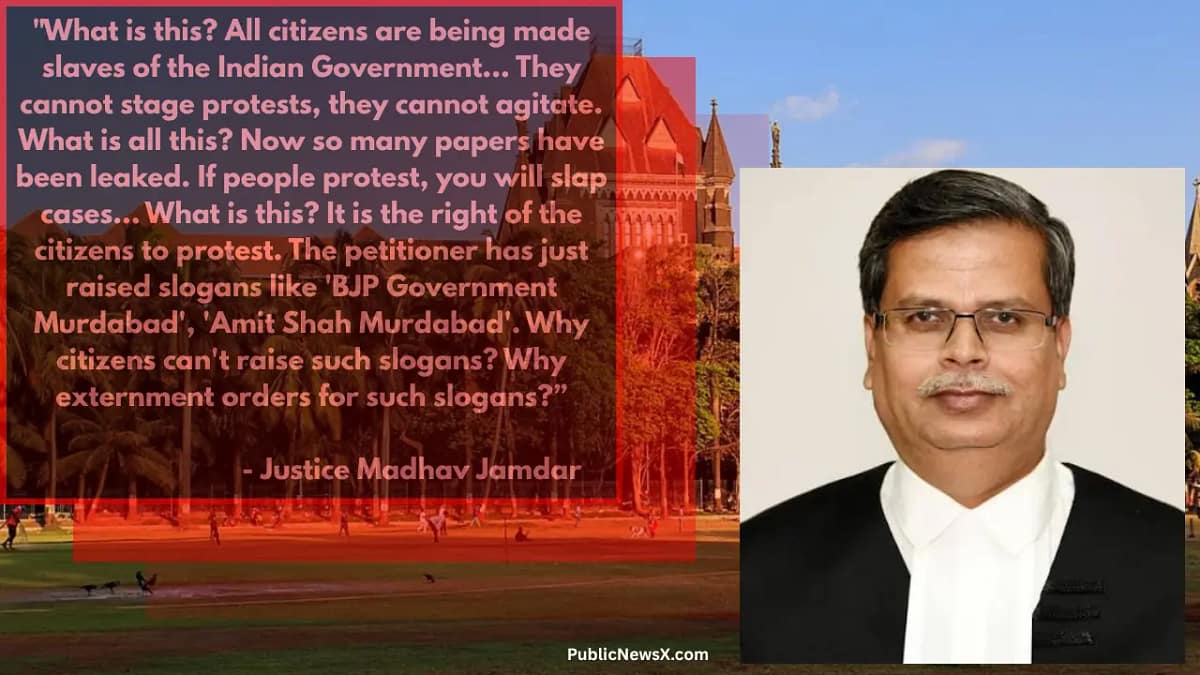
Mumbai, July 3: “What is this? All citizens are being made slaves of the Indian Government… They cannot stage protests, they cannot agitate. What is all this?”
Those were the sharp oral observations made by the Bombay High Court while quashing a one-year externment order against a political activist who had participated in protests and raised anti-government slogans.
Justice Madhav Jamdar set aside the externment order issued against Saeed Ahmad Abdul Wahid Chaudhary, Maharashtra General Secretary of the Social Democratic Party of India (SDPI), holding that participation in protests and raising slogans against the government could not, by themselves, justify such action.
The externment order, issued by the Deputy Commissioner of Police, Chembur, had barred Chaudhary from entering Mumbai and adjoining districts for one year. It was based on multiple FIRs registered over protests against issues including the Citizenship (Amendment) Act (CAA), the Gyanvapi dispute and alleged examination paper leaks.
During the hearing, Justice Jamdar questioned why the police had treated anti-government slogans as grounds for externment.
“It is the right of the citizens to protest. The petitioner has just raised slogans like ‘BJP Government Murdabad’ and ‘Amit Shah Murdabad’. Why can’t citizens raise such slogans? Why externment orders for such slogans?” the judge orally observed.
The court also reminded the police that they are accountable to the public, not political leaders.
“You are public servants. You are not servants of any ministers or political parties. You are servants of the public,” Justice Madhav Jamdar remarked.
After examining the record, the High Court held that the authorities had failed to establish sufficient material to justify the externment order. It ruled that participation in protests and expression of political dissent could not, on their own, be treated as grounds for restricting a citizen’s movement.
The court consequently quashed both the externment order passed by the Deputy Commissioner of Police and the appellate order that had upheld it.
The strong observations came during the hearing and form part of the court’s oral exchanges. In its written order, the High Court similarly found the externment legally unsustainable, observing that the authorities had failed to meet the statutory requirements for invoking such extraordinary powers.
Share this content: