
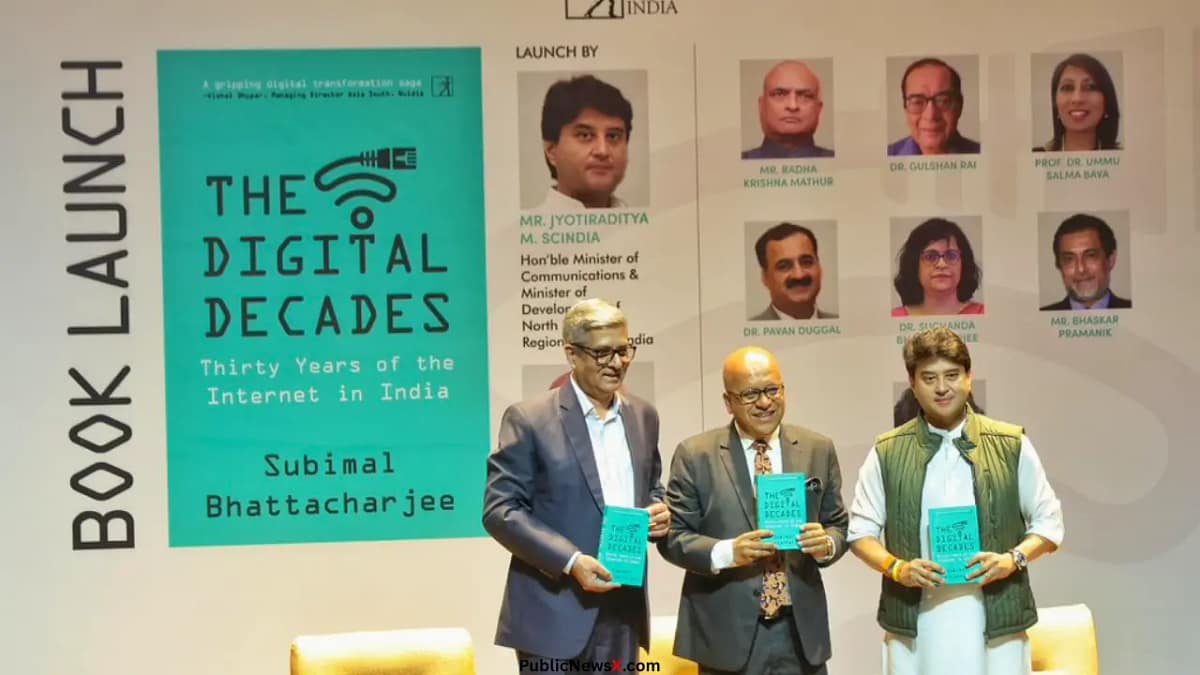
New Delhi: Union Minister Jyotiraditya Scindia says “the digital decade ahead belongs to Bharat” on February 26, 2026 in New Delhi as he addresses the launch of The Digital Decades: Thirty Years of the Internet in India, a book by Subimal Bhattacharjee that chronicles India’s internet journey, policy, technology and social impact.
The event evolves into both a celebration of India’s internet expansion and a sharp debate on the risks that accompany rapid technological growth.
Scindia describes India’s digital rise as swift and inclusive, particularly during the past 11 years under Prime Minister Narendra Modi. He recalls the era of Videsh Sanchar Nigam Limited dial up connections in 1995 and contrasts it with today’s more than one billion internet users. He cites the rapid 5G rollout and over 21 billion monthly UPI transactions as evidence of scale, ambition and execution.
Published in February 2026 by Simon & Schuster India, the book maps three decades of internet evolution. It traces the first public internet access in August 1995, follows liberalization that opens the sector to private players, examines the dot com boom and crash, documents the mobile telephony surge that expands connectivity, and studies policy shifts culminating in the Digital India initiative. Across 19 chapters, the author analyses how policy decisions, political contexts and technological breakthroughs reshape governance and everyday life.
The discussion quickly shifts from history to emerging threats.
Cyber law expert Pawan Duggal calls the current AI surge “cognitive colonialism.” He argues that over reliance on artificial intelligence systems risks weakening independent human thinking and creating new digital dependencies. His remarks introduce urgency into the conversation.
Dr. Suchanda Bhattacharjee from NIMS Hyderabad highlights health concerns linked to prolonged device usage. She says medical professionals increasingly observe hunched posture and slower reflex responses among heavy digital users. She suggests that deep technological immersion alters both physical posture and cognitive agility.
Sunetra Choudhury, National Political Editor at The Hindustan Times, raises concerns about teenage exposure to social media platforms. She supports stronger regulatory frameworks to safeguard children online. She and Dr. Bhattacharjee emphasise the need for structured oversight to mitigate potential harm.
Former Microsoft India Chairman Bhaskar Pramanik reflects on the speed of technological change. He says technology has the shelf life of a banana, underscoring rapid obsolescence. He stresses that cyber crime evolves just as quickly and demands sharper counter strategies.
Dr. Gulshan Rai, former National Cyber Security Coordinator, notes that bureaucratic leadership often drives India’s technological adoption. He places public policy at the core of digital progress.
The event presents two parallel realities. Leaders celebrate India’s transformation from dial up access to global digital scale. Experts simultaneously question whether institutions, regulatory systems and social frameworks can keep pace with artificial intelligence, platform dominance and data governance challenges.
The discussion captures both optimism and caution as India enters its next phase of digital expansion.
Share this content: