
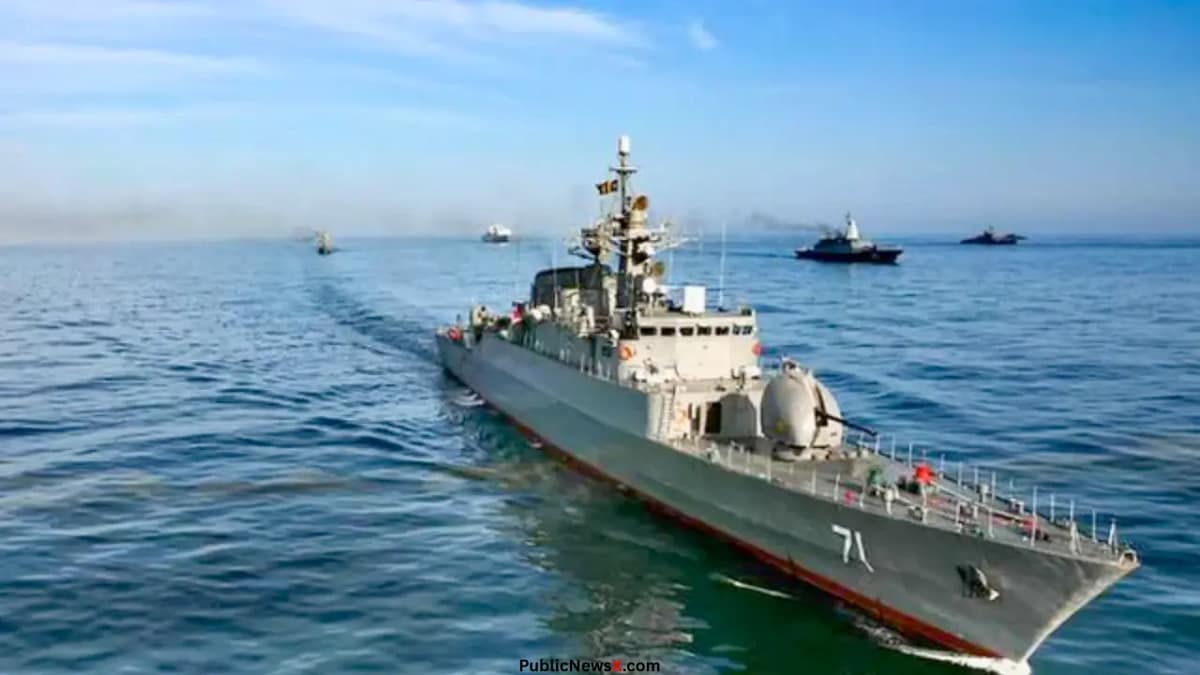
Galle / Washington / New Delhi: A United States Navy submarine torpedoed and sank the Iranian Navy frigate IRIS Dena in the Indian Ocean, days after the vessel participated in the multinational MILAN 2026 naval exercise hosted by India in Visakhapatnam.
IRIS Dena, a Moudge-class guided missile frigate commissioned in 2021, had recently taken part in India’s International Fleet Review 2026 and the MILAN 2026 maritime drills. The exercise brought together multiple navies for interoperability training, coordinated maneuvers and regional security cooperation.
The Iranian warship’s participation was viewed as part of Tehran’s broader effort to expand naval diplomacy and demonstrate blue-water operational capability beyond the Persian Gulf. After completing port calls and ceremonial events in Visakhapatnam, the vessel departed Indian waters and began its westward return journey through the Indian Ocean.
At the same time, tensions between Washington and Tehran were sharply escalating due to ongoing military exchanges in the Middle East, including missile and drone strikes targeting military infrastructure.
According to U.S. defense officials, an American submarine engaged and fired a torpedo at IRIS Dena while the vessel was operating in international waters approximately 40 nautical miles south of Galle, Sri Lanka.
The impact reportedly caused catastrophic structural damage, leading to rapid flooding and the eventual sinking of the frigate.
Pentagon officials described the operation as part of broader military actions tied to the intensifying US-Iran confrontation. The United States stated that the engagement marked the first time since World War II that a U.S. submarine had sunk an enemy warship using a torpedo.
The Iranian vessel reportedly transmitted a distress signal shortly after the strike, triggering an emergency response from Sri Lankan maritime authorities.
Sri Lanka’s Navy and Air Force launched immediate search and rescue operations in the waters south of Galle. Authorities confirmed that 87 crew members were recovered dead and 32 survivors were rescued and hospitalized.
Around 180 personnel were believed to be onboard at the time of the attack, leaving dozens still missing as recovery efforts continue.
The sinking has sent shockwaves across the region. The Indian Ocean is a critical maritime corridor for global trade, oil shipments and naval deployments. Any sustained military activity in these waters could disrupt shipping routes and raise maritime insurance costs.
India, which hosted the MILAN 2026 naval exercise attended by IRIS Dena, has not officially commented on the strike but is closely monitoring developments due to its strategic maritime interests.
Sri Lanka, though not a party to the conflict, has become directly involved through humanitarian rescue efforts.
Strategically, the incident widens the battlefield of the US–Iran conflict from the Middle East into the Indian Ocean, raising fears of further naval engagements. Analysts warn that the move could trigger retaliatory measures, increase military deployments and intensify global diplomatic pressure for de-escalation.
As search operations continue and diplomatic reactions unfold, the sinking of IRIS Dena stands as a defining moment in the expanding US–Iran naval confrontation, with implications for regional security, maritime stability and global geopolitics.
Share this content: