
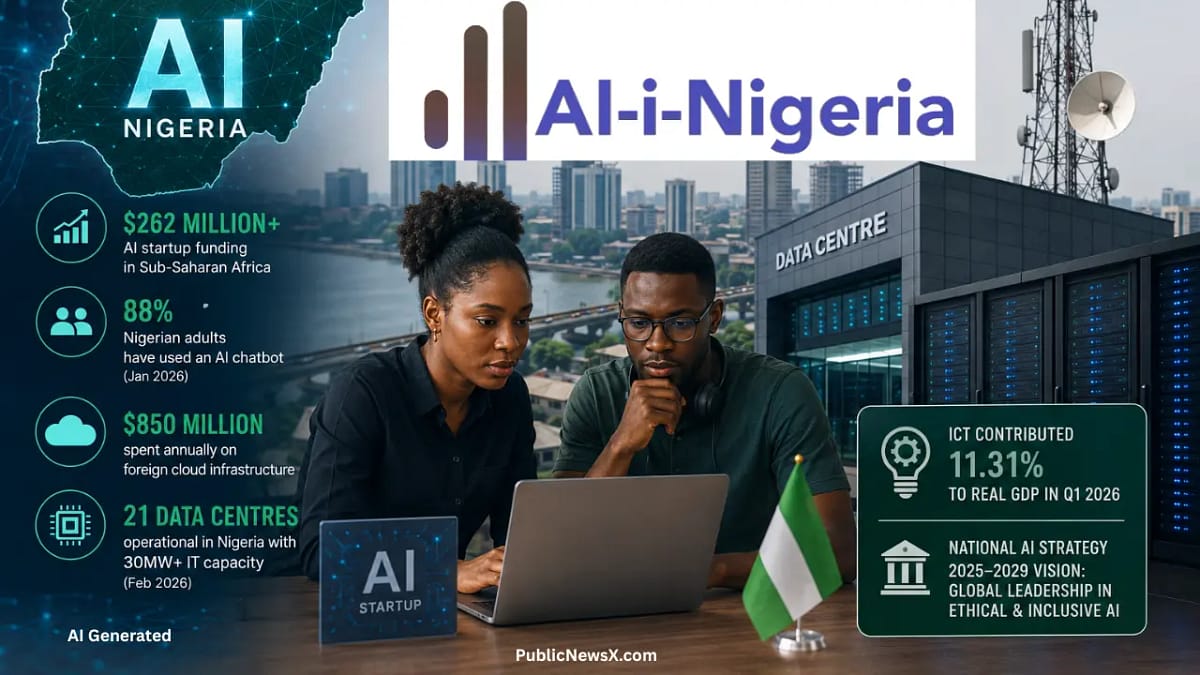
Lagos/ New Delhi: Artificial intelligence startups across Sub-Saharan Africa have raised more than $262 million from external investors, with Nigeria among the leading markets on the continent, according to the Africa Interconnection Report 2025, researched by Balancing Act and commissioned by global connectivity platform Console Connect.
Nigeria’s AI ecosystem spans sectors including financial technology, health technology, agricultural technology, and language processing. The country accounts for a significant share of activity within the Sub-Saharan African AI funding pool, alongside South Africa and Kenya.
Consumer adoption of AI is high in Nigeria. A survey by Google and Ipsos published in January 2026 found that 88 per cent of Nigerian adults have used an AI chatbot, representing an 18-percentage-point increase from 2024 and well above the global average of 62 per cent.
Professional adoption, however, presents a different picture. Microsoft’s Global AI Diffusion Q1 2026 Trends and Insights report placed Nigeria’s working-age AI adoption rate at 10.1 per cent in the first quarter of 2026, below the global average of 17.8 per cent and the 15.4 per cent average recorded across the Global South.
The gap is driven largely by infrastructure constraints. Limited broadband access, inconsistent electricity supply, and high data costs continue to restrict wider AI adoption across businesses and institutions.
Cost remains another significant barrier. Most widely used AI tools are priced in US dollars at a time when the naira remains under sustained pressure, placing them beyond the budgets of many Nigerian small and medium-sized enterprises.
The cloud computing market illustrates the scale of the opportunity. Expert Market Research valued Nigeria’s cloud computing market at $1.05 billion in 2025 and projected it would reach $11.19 billion by 2035, expanding at a compound annual growth rate of 26.7 per cent.
Much of that spending currently flows offshore. Nigerian enterprises spend an estimated $850 million annually on foreign cloud infrastructure, according to Kasi Cloud Datacenters, whose Lekki campus was commissioned in May 2026 as West Africa’s first hyperscale-ready, AI-capable data centre platform.
MTN Nigeria has also invested $235 million in its Sifiso Dabengwa Data Centre in Lagos, a Tier III facility opened in July 2025. The company launched a naira-priced cloud platform alongside the data centre. As of February 2026, Nigeria had 21 operational data centres with a combined IT capacity exceeding 30 megawatts, according to industry tracking data.
The ICT sector contributed 10.07 per cent to Nigeria’s real GDP in 2025, according to the National Bureau of Statistics. In the first quarter of 2026, the sector’s contribution increased to 11.31 per cent. Telecommunications alone contributed 9.19 per cent, equivalent to N4.71 trillion, during Q1 2026.
At the policy level, the Federal Executive Council approved the establishment of the National Artificial Intelligence Trust in February 2025. Nigeria’s National Artificial Intelligence Strategy, published in September 2025, sets out a five-year vision running through 2029 for the country to become a global leader in ethical and inclusive AI innovation.
Share this content: