
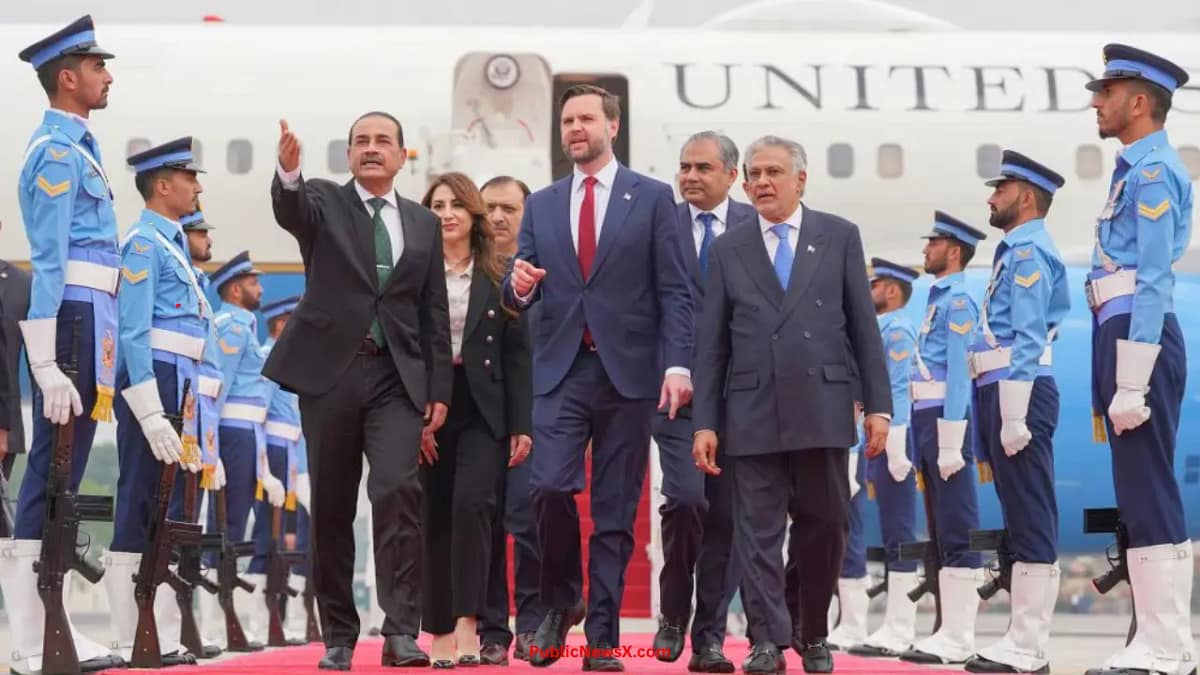
On April 8, 2026, President Donald Trump announced a two-week ceasefire between the United States and Iran, brokered primarily through Pakistan after nearly seven weeks of devastating conflict.
Iran agreed to reopen the Strait of Hormuz, while the US paused its strikes. Trump declared on Truth Social that Iran had committed to “never have a nuclear weapon,” framing the pause as a pathway to deeper negotiations.
Pakistan’s emergence as the central mediator was swift and pivotal. On April 10, Prime Minister Shehbaz Sharif publicly invited both sides to Islamabad for what he called “make or break” talks.
“In response to my sincere invitation, the leaderships of both countries are coming to Islamabad. There, negotiations will be held for the establishment of peace… This is that stage which, in English, is called the equivalent of ‘make or break’,” Sharif stated in a national address.
The historic Islamabad talks took place on April 11–12 at the Serena Hotel. A US delegation led by Vice President JD Vance, accompanied by Jared Kushner and Steve Witkoff, engaged Iranian representatives headed by Parliament Speaker Mohammad Bagher Ghalibaf and Foreign Minister Abbas Araghchi in 21 hours of intense negotiations.
No deal emerged. Vance later said: “The bad news is that we have not reached an agreement. And I think that’s bad news for Iran much more than it’s bad news for the United States of America… they have chosen not to accept our terms.”
He stressed the U.S. demand for “an affirmative commitment that they will not seek a nuclear weapon” and described the American proposal as “our final and best offer.” Trump reinforced the red line: “No nuclear weapon. That’s 99% percent of it.”
Pakistan continued its shuttle diplomacy. On April 15, Army Chief Field Marshal Asim Munir led a high-level delegation including Interior Minister Mohsin Naqvi to Tehran.
Iranian Foreign Minister Abbas Araghchi welcomed them warmly, describing the visit as aimed at narrowing gaps and delivering a fresh U.S. message ahead of a potential second round in Islamabad before the April 22 expiry.
How did Pakistan suddenly become Washington’s trusted bridge to Tehran?
The story traces back to dramatic shifts in 2025. Following India’s Operation Sindoor, a May 7–10 military campaign involving missile and airstrikes on alleged terror infrastructure in Pakistan and Pakistan-administered Kashmir, Pakistan faced significant pressure.
The brief but intense conflict ended in a US-facilitated ceasefire. Then came Asim Munir’s high-profile US visit in August 2025. During a private dinner with the Pakistani-American community in Tampa, Florida, Munir reportedly declared: “We are a nuclear nation. If we think we are going down, we’ll take half the world down with us.”
The remarks, widely reported by Indian and international media (though Pakistan’s Foreign Office called them distorted), came on American soil and drew strong Indian condemnation as nuclear sabre-rattling.
This episode, amid post-Sindoor realignments and warming US-Pakistan ties under Trump, appears to have positioned Munir as a key interlocutor. Yet one piece of this puzzle remains mysterious: the precise calculus that transformed a nation recovering from direct confrontation with India into the indispensable mediator between Washington and Tehran.
Coincidence, strategic reset, or deeper backchannel understandings? This piece of the puzzle is still mysterious.
That same April 8, even as the Iran truce was announced, violence erupted on parallel fronts. Israel launched “Operation Eternal Darkness” with over 100 rapid airstrikes across Lebanon, targeting Hezbollah positions in Beirut’s southern suburbs, southern Lebanon, and the Bekaa Valley.
Lebanese authorities reported hundreds killed and over a thousand injured. Hezbollah showed restraint in line with Iran’s de-escalation push, but Israel pressed forward to neutralize what it called an existential threat.
In Gaza, tragedy compounded the horror. An Israeli drone strike on al-Rashid Street killed Al Jazeera correspondent Mohammed Wishah and others. Al Jazeera condemned it as targeted; Israel claimed militant ties. Multiple journalists died that day, drawing international calls for accountability.
By April 15–16, US pressure and Pakistani mediation helped converge threads. On April 16, Trump announced via Truth Social: “I just had excellent conversations with the Highly Respected President Joseph Aoun, of Lebanon, and Prime Minister Bibi Netanyahu, of Israel.
These two Leaders have agreed that in order to achieve PEACE between their Countries, they will formally begin a 10 Day CEASEFIRE at 5 P.M. EST.” He invited both to the White House.
Lebanese responses were measured. President Joseph Aoun thanked Trump for efforts toward “lasting peace and stability” while refusing direct talks with Netanyahu at this stage.
Prime Minister Nawaf Salam welcomed the truce as a “central Lebanese demand” to enable returns of the displaced.
Netanyahu confirmed the pause but insisted Israeli forces would remain in a southern security zone and that Hezbollah must be dismantled. Hezbollah demanded a comprehensive halt with no Israeli freedom of movement.
As of April 17, the Lebanon 10-day truce is in its early hours, the Iran two-week ceasefire is midway, and prospects for Islamabad 2.0 loom. Trump’s nuclear narrative holds firm, even as enrichment disputes persist. The human cost, thousands dead, millions displaced, economies shattered.
India’s GDP slips to 6th largest economy according to IMF data.
While Trump’s transactional diplomacy has drawn Pakistan closer as a mediator, critics in New Delhi argue that the US is effectively bullying India, leveraging post-Operation Sindoor pressure and Trump’s repeated claims of having restrained PM Modi to force deeper strategic alignment with Israel, even as the new US-India trade framework delivers greater benefits to American exporters and imposes heavier adjustment burdens on Indian industry and agriculture.
Domestically in India, the cumulative fallout has been costly. The Middle East turmoil has already exacted a heavy economic toll through elevated energy prices, widened current account deficit, rupee pressure, and risks to the ~$50 billion in annual remittances from over 9 million Indian workers in the Gulf.
Analysts estimate these interconnected conflicts could shave 0.5–1% off India’s GDP growth for FY 2026–27.
Post-Operation Sindoor military expenditures and disrupted trade have compounded the strain, while the February 2026 US-India interim trade framework with India’s commitment to large-scale purchases of American energy, aircraft, tech, and agricultural goods is seen in Indian policy circles as disproportionately favouring the United States.
This war is actually costing more to India economically.
Share this content: