
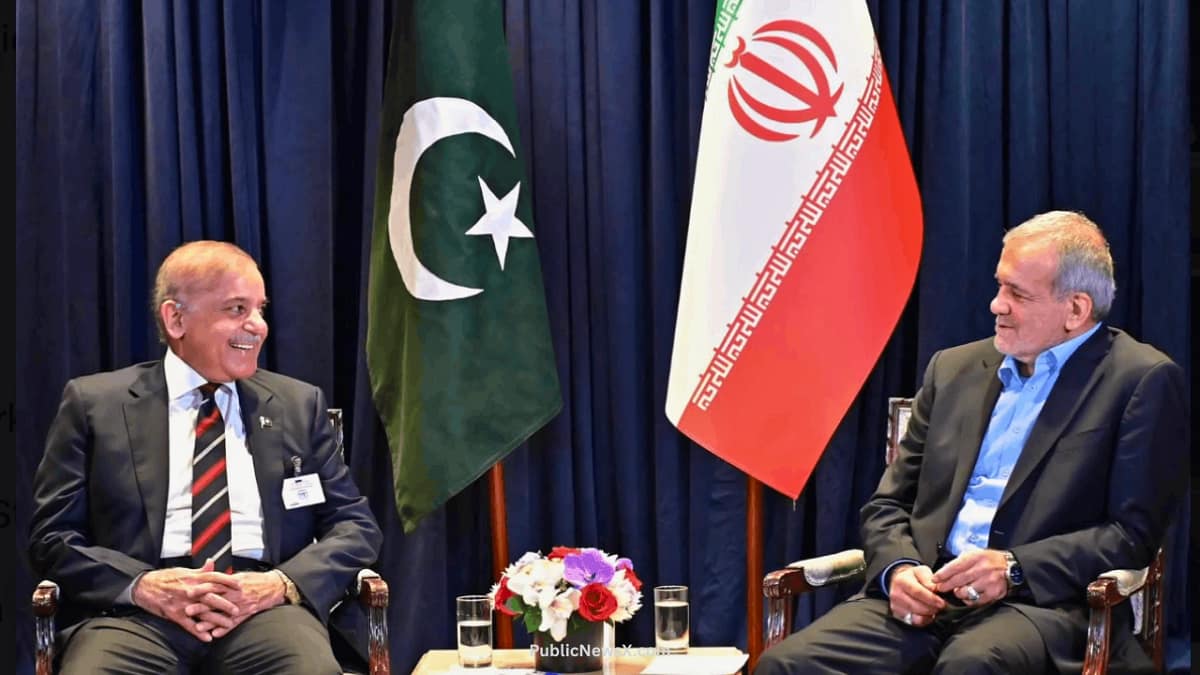
New Delhi/Islamabad: Iranian President Masoud Pezeshkian and Pakistani PM Shehbaz Sharif presented a carefully coordinated message in Islamabad on Tuesday following high-level talks, reaffirming that Iran’s ballistic missile programme remains non-negotiable and was never included in the recent Islamabad Memorandum of Understanding (MoU) with the United States.
Standing alongside the Iranian president, Sharif criticized what he described as “double standards” in international security debates.
Pezeshkian was even more direct, arguing that Iran’s missile capabilities serve as a defensive shield and suggesting that without them, the country could have faced the same fate as Gaza under pressure from the United States and Israel.
The Iranian leader also dismissed what he called Western “human rights rhetoric” as a “big lie,” while maintaining that Tehran remains open to meaningful dialogue and diplomatic engagement.
The remarks reflected a tone of caution rather than celebration. Both leaders appeared mindful of the costs of the 2026 regional conflict, which erupted in late February and disrupted energy markets, threatened commercial shipping routes and claimed numerous lives across the region.
The mid-June MoU between Iran and the United States helped secure a ceasefire, reopen the Strait of Hormuz, provide limited sanctions relief and establish a 60-day framework for further discussions on nuclear-related issues. However, major questions remain about implementation, verification mechanisms and long-term political commitments.
Pezeshkian described his visit to Islamabad as recognition of Pakistan’s role in facilitating dialogue during a period of heightened tensions. He emphasized the strategic importance of Iran-Pakistan cooperation in both security and economic affairs.
Sharif echoed those sentiments, pledging what he called an “iron wall of unity” against efforts to undermine the emerging diplomatic process.
Their joint defence of Iran’s missile programme highlights one of the central tensions shaping regional diplomacy today: the balance between national sovereignty and deterrence on one hand, and international demands for military restraint on the other.
Echoes Across the Muslim World
Beyond the bilateral relationship, the meeting reflected wider concerns shared across much of the Muslim world.
Many regional states continue to navigate a complex landscape marked by external military interventions, transnational militancy, economic vulnerabilities and the growing risks posed by conflicts around critical trade corridors such as the Strait of Hormuz.
The deaths of three Indian seafarers during attacks on tankers near the strait earlier this month underscored how quickly geopolitical confrontations can spill into civilian life and global commerce.
While discussions of a unified Muslim political bloc periodically resurface during moments of crisis, such ambitions have historically been constrained by competing national interests. Gulf states maintain their own security calculations and economic priorities, while countries such as Turkey pursue independent strategic paths.
Yet practical cooperation on issues such as border security, energy connectivity, maritime safety and countering extremist threats continues to gain importance.
For Pakistan and Iran, despite periods of friction in recent years, stability along their shared frontier and economic recovery remain common priorities. Their discussions suggest an effort by regional middle powers to create diplomatic space amid intensifying competition among larger global actors.
A Pause, Not a Resolution
Underlying the public statements was a clear sense of realism.
Dialogue without security guarantees often struggles to survive. Equally, military deterrence without diplomacy risks perpetuating cycles of confrontation.
Pezeshkian’s defence of Iran’s missile programme, supported by Sharif, raises broader questions that extend beyond the current crisis. Who determines the limits of national self-defence? Which states are permitted strategic deterrence, and under what conditions? At what point does deterrence become destabilization?
The recent ceasefire has brought temporary relief. Energy markets have steadied, and commercial shipping through the Strait of Hormuz has gradually resumed. However, trust remains fragile.
The technical negotiations scheduled in the coming weeks will determine whether the current pause evolves into a more durable framework or collapses under renewed suspicion.
For much of the region, the lesson may be less about ideological unity and more about pragmatic cooperation. Shared challenges increasingly require coordinated responses, even among states with differing political systems and strategic priorities.
Whether the Islamabad meeting becomes a historical footnote or a modest diplomatic precedent will depend on what follows. The Middle East and South Asia have witnessed enough conflict to understand that ceasefires alone do not create stability.
For now, the ceasefire has created breathing space, but not certainty. Trust remains fragile, regional rivalries remain unresolved, and the hardest negotiations are still ahead.
The question is no longer whether the guns can fall silent, but whether the leaders who welcomed this pause can transform it into a durable peace – or whether the next crisis is already taking shape beneath the surface.
Share this content: