

NEW DELHI: The Nifty 50 recorded its seventh consecutive weekly decline in the week ended September 25, 2026, marking its longest losing streak since the Covid-19 market crash of 2020. The benchmark index closed at 23,140.50, down 205.90 points, or about 0.9%, from the previous week’s close of 23,346.40.
The latest decline extended a prolonged period of weakness in Indian equities, with investors facing pressure from elevated crude oil prices, rising government bond yields, foreign institutional selling and uncertainty surrounding global markets.
The seven-week losing streak is the longest for the Nifty since February-April 2020, when the index also declined for seven consecutive weeks during the global sell-off triggered by the Covid-19 pandemic. Reuters reported that the Nifty had recorded seven or more consecutive weekly losses only four times in the previous 25 years, including in 2020, 2008 and twice in 2001. Its longest losing streak was nine weeks in 2001.
Nifty 50 weekly close
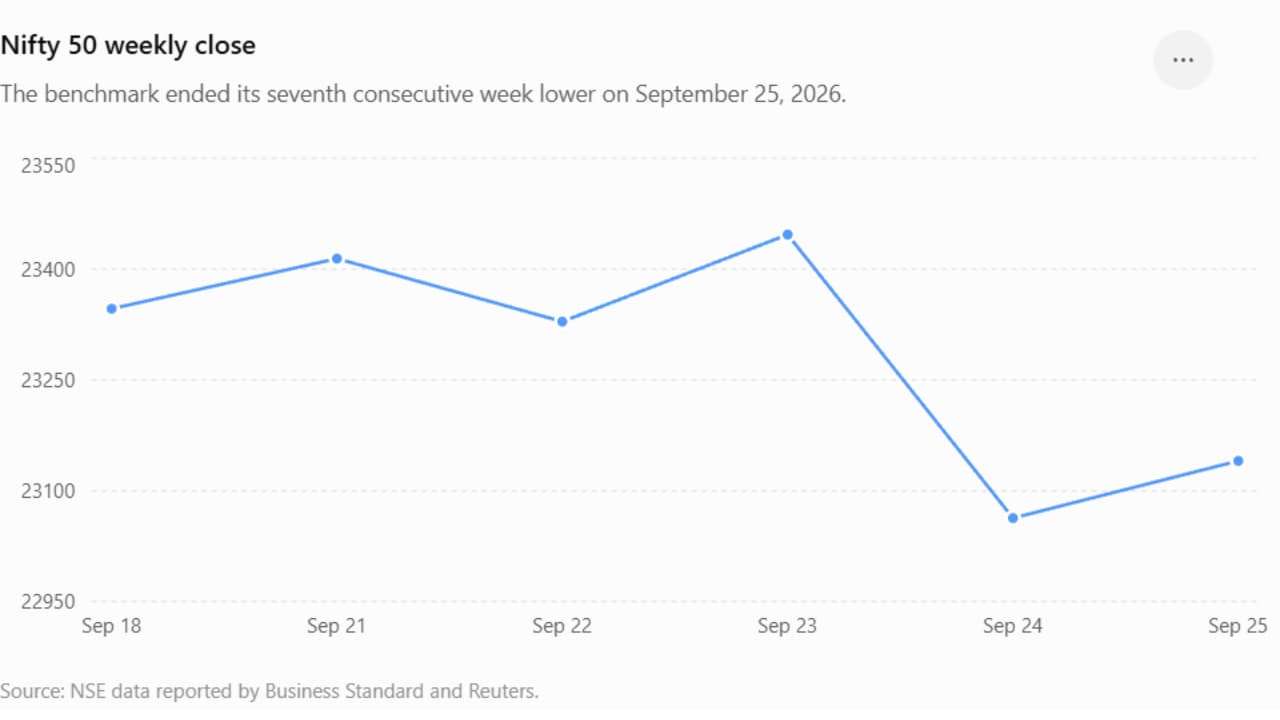
The benchmark ended its seventh consecutive week lower on September 25, 2026.
2295023100232502340023550Sep 18Sep 21Sep 22Sep 23Sep 24Sep 25
Source: NSE data reported by Business Standard and Reuters.
Rising global yields added to pressure on Indian equities
One of the key factors weighing on markets was the sharp rise in global bond yields. The US 10-year Treasury yield climbed to levels not seen since 2007, while the US 10-year and 30-year yields touched 5.18% and 5.35%, respectively, during the week, according to Business Standard.
Higher US yields can make dollar-denominated assets relatively more attractive and increase the cost of capital globally. For emerging markets such as India, sustained higher global yields can also make foreign investors more cautious about allocating money to domestic equities.
India’s own 10-year government bond yield rose five basis points during the week to 7.119%, its highest close since May 18. Business Standard reported that the benchmark yield had risen 46 basis points since the start of the Iran war and 62 basis points over the preceding year.
Oil prices remained a major concern for India
Crude oil has emerged as a major source of uncertainty for Indian markets because India imports most of its crude requirements.
Brent crude had touched around $106 a barrel during the week as markets continued to assess supply risks linked to the conflict involving the US and Iran. Reuters reported that Brent was around $105.5 a barrel on September 25.
The combination of elevated oil prices and higher bond yields has raised concerns over inflation, corporate costs and the broader economic outlook.
There was some relief in crude prices by the end of the week. Business Standard reported that Brent fell 11.5% during the week to $98.59 a barrel, from $111.35 on September 18. Despite that decline, the market remained sensitive to renewed geopolitical developments that could disrupt energy supplies.
That risk resurfaced after the weekend. On September 29, Brent crude rose about 1.5% to $107 a barrel as concerns over supply disruptions linked to the US-Iran conflict intensified. The Nifty subsequently fell to around 22,606 in morning trading, close to a six-month low.
Foreign investor selling added to market weakness
Foreign institutional investor flows have also remained an important factor behind the pressure on Indian equities.
On September 28, FIIs sold ₹5,353.22 crore of Indian equities, their biggest single-day outflow of September, according to NSE data cited by Moneycontrol. Domestic institutional investors partly offset the selling by purchasing ₹5,189.02 crore.
The selling came as higher oil prices, rising bond yields and a weaker rupee increased concerns about India’s inflation and external balance.
The rupee ended the September 18-25 week at ₹95.82 against the US dollar, marginally weaker than the previous week, according to Business Standard.
Financial and IT stocks were among the major drags
The weakness was not confined to a single sector. Reuters reported that 11 of the 16 major sectoral indices declined during the week.
Financial stocks fell 1.6%, while information technology stocks declined 2.4%, marking their fourth consecutive weekly losses.
Financial stocks also faced pressure from concerns surrounding proposed changes to insurance-sector commission structures. Business Standard reported that insurance companies collectively lost about ₹7,000 crore in market value during the week, while PB Fintech lost about 33%, wiping out roughly ₹28,000 crore in market value.
IT stocks, meanwhile, remained sensitive to expectations of higher US interest rates and concerns surrounding the impact of artificial intelligence on the technology sector.
Tata group developments added another layer of uncertainty
Domestic corporate developments also contributed to market volatility during the week.
The Tata group remained in focus after Tata Trusts proposed changes involving Tata Sons and related group entities. Business Standard reported that 18 of the group’s 23 listed companies declined during the week, with the group collectively losing about ₹40,681 crore in market value before gains in five other companies reduced the overall loss.
The developments added to broader concerns about corporate structures and regulatory requirements, although market participants also expressed the view that the issues could be resolved through further discussions.
NSE listing fails to lift broader market sentiment
The week also marked the long-awaited stock-market listing of the National Stock Exchange of India. The exchange made a relatively muted debut and was valued at roughly $47 billion after listing, according to Reuters.
The listing came at a time when the broader market was being driven more by global macroeconomic and geopolitical factors than by domestic corporate events.
Small and mid-cap stocks also declined
The selling pressure extended beyond large-cap stocks.
Reuters reported that the Nifty small-cap index fell 0.9% and the mid-cap index declined 2.1% during the week ended September 25. The Nifty India VIX, a measure of expected market volatility, also rose during the week, reflecting increased uncertainty among investors.
Coal India was among the notable Nifty 50 gainers during the week, rising about 4% on expectations of stronger demand and earnings. However, gains in individual stocks were not enough to prevent the benchmark from extending its weekly losing streak.
The decline has continued into the new week
The market’s weakness did not end with the seventh weekly fall.
On September 29, Indian equities came under renewed pressure as Brent crude climbed to about $107 a barrel. The Nifty 50 fell 0.77% to 22,606.1 in morning trading, while the Sensex declined 0.82% to 72,179.87. Both benchmarks touched their lowest levels since early April during the session.
Fourteen of the 16 major sectoral indices were trading lower, while financials, banks and IT stocks each fell more than 1%. HDFC Bank, ICICI Bank and Reliance Industries were among the major heavyweight stocks under pressure.
The latest moves mean the market has entered a new week with the pressure that produced the seven-week losing streak still present, particularly from crude oil, global bond yields, foreign fund flows and geopolitical uncertainty.
For investors, the key variables remain the direction of oil prices, developments in the US-Iran conflict, global interest rates and bond yields, foreign institutional flows and the rupee. Their combined movement is likely to remain important for Indian equities as the market assesses whether the prolonged decline can stabilise.
Share this content: