
New Delhi: The Union Petroleum Minister told Parliament on 12 March 2026 says that India’s LPG supply is protected and stable. So why, in Abul Fazal Enclave home to students of Jamia Millia Islamia and thousands of working-class Muslim families dependent on the local economy facing brunt of price hikes.
Commercial cylinders vanished entirely from the market? Why are restaurant owners and small shop keepers buying domestic cylinders at ₹3,000 a piece on the black market, just to serve iftar and sehri meals this Ramzan? Every year, these lanes fill with smoke from kebab grills and the sound of chaiwallas doing their best trade of the year.
This year, the grills are lit but at a cost. Minister has not explained it in the parliament.
While Union Petroleum Minister Hardeep Singh Puri told Parliament on 12 March that supply to 33 crore households remains protected and that the domestic LPG delivery cycle continues at about 2.5 days, a visit to this densely populated, working-class neighbourhood tells a more complicated story.
Restaurant owners here speak of cylinders bought for ₹3,000 to ₹4,000, menus quietly revised, and milk going unsold during the holiest month of the year.
Shahdil Sheeraj, who runs Lulu Kabab, one of the neighbourhood’s more established dine-in restaurants, describes the change in simple terms. His commercial LPG cylinder, 19-kg variety that once cost around ₹1,900 is now available only at prices that have more than doubled.
“Today I bought one cylinder for ₹3,000,” Sheeraj says.
“Earlier I used to charge ₹200 for a quarter Chicken Changeezi and four parathas. Now I charge ₹220. The main burden is on the consumer.”
The price change a 10 percent increase on a flagship dish may appear modest on paper. But in a locality where working-class families come to eat, even a ₹20 rise per plate matters. Sheeraj says footfall has already begun to decline.
Across the lane, other restaurant owners describe similar problems. Several say they were quoted ₹3,500 per commercial cylinder. At least two say they paid as much as ₹4,000 to keep their tandoors running.
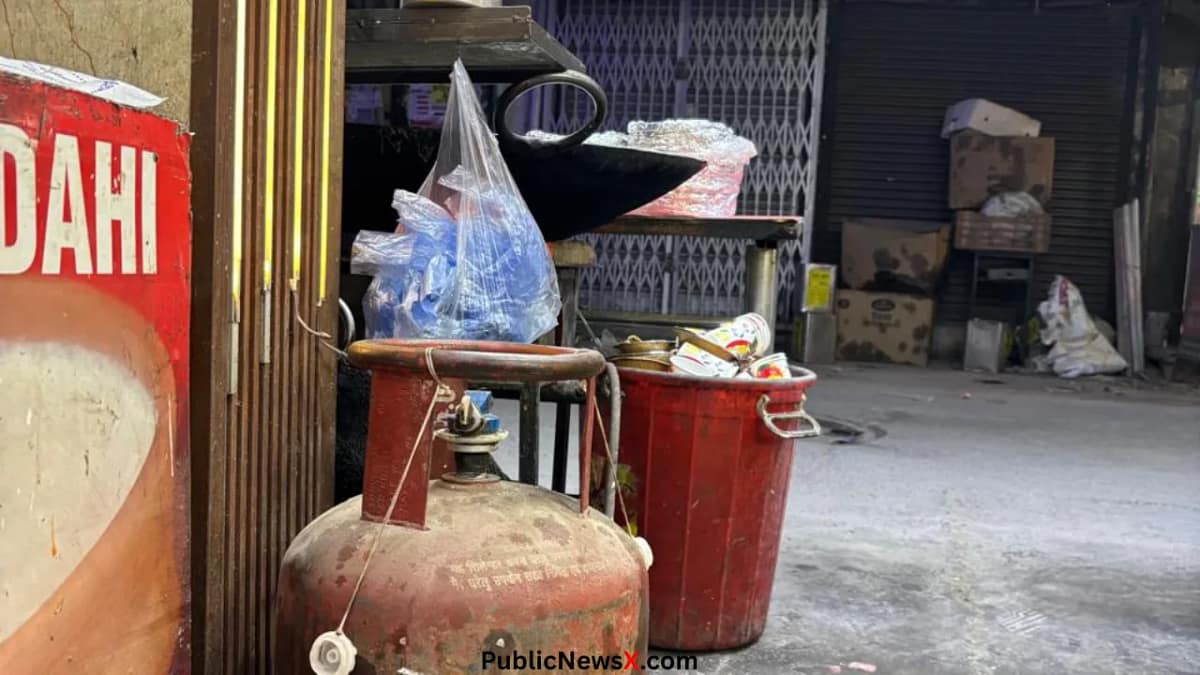
Almost all point to the blue commercial cylinders now quietly replacing their kitchens with 14.2-kg household cylinders that are technically illegal for commercial use.
The government’s response to the LPG shortage, outlined in a statement from the Ministry of Petroleum and Natural Gas, restricts commercial LPG supply to 20 percent of the average monthly requirement.
The policy prioritises household cooking gas while cutting supply to restaurants and other commercial users.
The result is visible throughout Abul Fazal Enclave. Commercial establishments are filling the gap with domestic cylinders. These cylinders officially cost ₹913-1100 in Delhi. But several restaurant owners say they now buy them for ₹2,000 to ₹3,500 on the black market.
Authorities say anti-diversion raids are underway across the capital. None of the ten businesses visited by reporter said they had seen an inspection in recent days.
One chai vendor, who asked not to be named, says he has little choice. “If I use a commercial cylinder now, where will I find it? And if I find it, who can pay ₹4,000?” he asks, pointing to the blue cylinder under his counter. “This is what everyone is using.”
The crisis comes at the worst possible time for Abul Fazal Enclave. Ramzan usually brings the busiest weeks of the year for food vendors. Sehri and iftar meals draw large crowds each evening. This year, several businesses say sales have slowed.
Matloob Goshi, who runs a dairy stall selling milk, curd, paneer and sweets, says the LPG shock has spread through the local economy. “I sell milk and dairy products, but prices of milk and curd have increased because of gas prices,” he says. “Now it is Ramzan season. Earlier I sold more milk. Now customers are buying less.”
Goshi says customer traffic at his shop has dropped.
The pattern he describes reflects a wider chain reaction. Higher gas costs raise the price of processing milk at the distributor level. Vendors then raise prices. Customers respond by buying less.
Ramzan normally the busiest time of year has instead brought quiet afternoons.
In Parliament this week, the government described India’s fuel position as stable. Refineries are operating above 100 percent capacity. New LPG supplies are being sourced from the United States, Norway, Canada, Algeria and Russia.
The minister also said the Saudi Contract Price for LPG rose 41 percent between July 2023 and March 2026, but the government absorbed part of the increase to shield consumers.
What the official statement does not address is the last-mile reality visible in neighbourhoods like Abul Fazal Enclave.
Industry bodies say the problem is spreading. The National Restaurant Association of India warned earlier this week that as many as 60 percent of restaurants could shut within two to three days without restored commercial LPG supply.
Structural data adds to the concern. India currently has only two underground LPG storage caverns, providing a strategic buffer of less than two days of national consumption. Unlike crude oil, India does not maintain a formal strategic LPG reserve policy.
Alternative LPG shipments from Western suppliers also take longer to reach Indian ports. Industry estimates suggest these routes add 25 to 35 days of transit time, compared with seven to twelve days for shipments from Gulf ports through the Strait of Hormuz.
In Abul Fazal Enclave, however, these logistics are distant concerns.
What matters is whether Shahdil Sheeraj can find a cylinder at a price that does not force him to raise his menu again. It matters whether Matloob Goshi’s customers return before Eid.
For now, the commercial cylinders remain parked outside restaurants.
The kitchens keep running.
But the arithmetic, as every shopkeeper here says, is getting harder.
Share this content: