US Forces Board Russia Linked Tanker Aquila II After 10,000 Mile Indian Ocean Chase
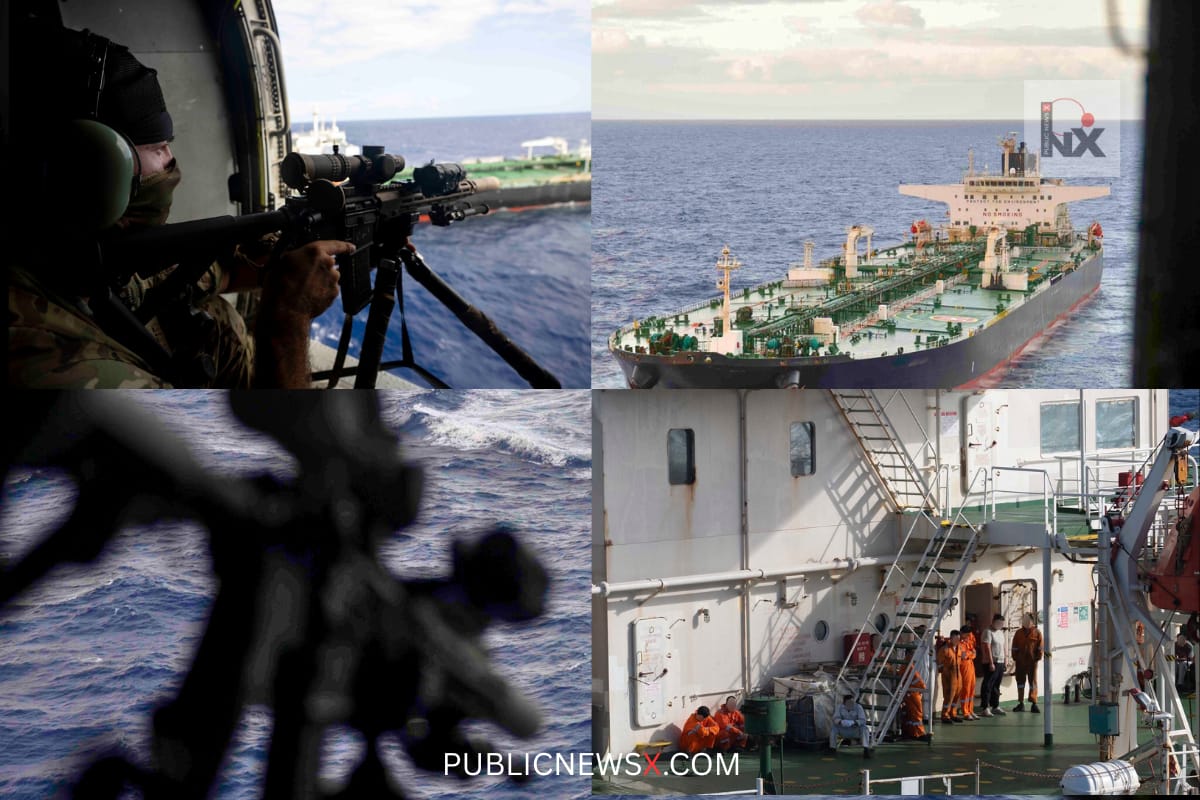
Washington / New Delhi: US military forces boarded the sanctioned oil tanker Aquila II in the Indian Ocean late on February 9, US time. The action ended a pursuit that stretched more than 10,000 nautical miles from the Caribbean Sea.
The Department of war said the operation was carried out under the right of visit and maritime interdiction rules. It was completed without resistance. No injuries were reported. No shots were fired.
Defence Secretary Pete Hegseth confirmed the boarding on X. He said the vessel tried to evade authorities and was tracked across oceans. He added that the United States has the ability to enforce actions far from its shores.
The Aquila II is a Panamanian flagged crude oil tanker. It is a Suezmax class vessel about 274 meters long. US officials said it was carrying around 700,000 barrels of Venezuelan heavy crude. The cargo was believed to be bound for refineries in China.
The tanker left Venezuela from the Jose terminal in early January 2026. Some reports say it previously sailed under an alias. It took the longer route around the Cape of Good Hope. Officials said the vessel was heading toward the Sunda Strait to avoid Red Sea attacks.
US authorities allege the ship is part of a shadow fleet used to move sanctioned oil. Such vessels often switch off tracking systems to avoid detection.
The Aquila II is linked to Sunne Co Limited, a company under US sanctions with Russian ties. The ship has also been designated by the European Union and the United Kingdom for sanctions violations.
This was the first known US boarding of a sanctioned tanker in the Indian Ocean during the current crackdown on Venezuelan oil exports. Earlier interdictions mostly took place in the Caribbean. In this case, the tanker was boarded and inspected but not immediately taken into US custody. Officials said its final status is still under review.
The operation involved US Navy ships and aircraft under Indo Pacific Command. Pentagon video showed forces descending onto the deck from a helicopter in open seas.
US officials said the interception occurred in international waters. It did not involve Indian waters.
The ongoing tensions between the United States, Russia, and Venezuela over oil revolve around long-standing U.S. sanctions on Venezuela’s oil sector. The conflict has deepened because of Russia‘s strong support for Venezuela.
This includes major energy investments (such as by Rosneft), joint deals, and the shared use of a “shadow fleet”—a network of aging, often falsely flagged tankers that evade Western sanctions by transporting Venezuelan crude (sometimes blended with Russian or Iranian oil) to markets like China.
Tensions escalated sharply in late 2025 and into 2026 under the Trump administration. The U.S. intensified sanctions on the shadow fleet, seeing it as a key lifeline for sanctioned regimes (Venezuela, Russia, and Iran) and a challenge to global energy security.
This led to Operation Southern Spear, which ramped up enforcement starting in December 2025. The operation gained momentum after U.S. forces captured Venezuelan President Nicolás Maduro in a raid on Caracas on January 3, 2026.
The goal was to choke illicit oil revenues funding the Maduro government (and Russian influence), while potentially allowing American firms to regain influence over Venezuela’s oil production, sales, and profits. Russia has accused the U.S. of illegally pushing Russian companies out of Venezuela’s energy sector and reshaping global oil dynamics to favour American dominance.
U.S. military and Coast Guard forces have shifted from financial measures to direct maritime interdictions, boarding and seizing sanctioned tankers (often with Russian ties) linked to Venezuelan exports.
Since December 2025, eight such vessels have been intercepted or seized. These include early actions in the Caribbean (such as the Skipper, Centuries, M Sophia, Olina, Veronica, and Sagitta), one in the North Atlantic (Marinera, a Russian-flagged tanker), and now the Aquila II in the Indian Ocean on February 9, 2026.
Share this content:


Post Comment