
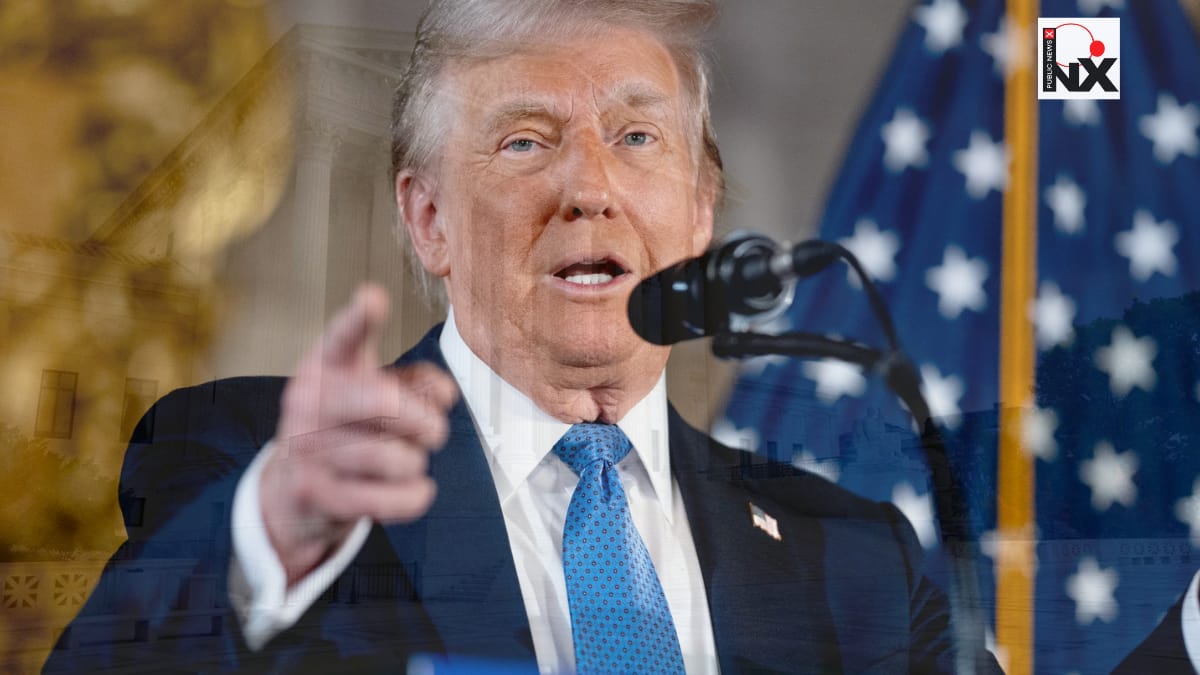
New Delhi: President Donald J. Trump lashed out at the United States Supreme Court on Friday after the nation’s highest court delivered a stunning 6-3 ruling invalidating his sweeping tariffs imposed under emergency powers in one of the most consequential rebukes of executive authority in modern American history.
The case, Learning Resources, Inc. v. Trump, saw the Court uphold two lower courts including the U.S. Court of International Trade that had previously found Trump lacked the authority to impose global tariffs under the International Emergency Economic Powers Act (IEEPA).
Writing for the majority, Chief Justice John Roberts emphasized that the Constitution assigns the power to impose taxes and duties to Congress, and that IEEPA historically used to freeze assets and impose sanctions does not clearly authorize the President to levy tariffs of indefinite scope and duration. “The President asserts the extraordinary power to unilaterally impose tariffs of unlimited amount, duration, and scope,” Roberts wrote. “In light of the breadth, history, and constitutional context of that asserted authority, he must identify clear congressional authorization to exercise it.”
Roberts was joined in the majority by Justices Elena Kagan, Sonia Sotomayor, Ketanji Brown Jackson and crucially two of Trump’s own appointees: Justices Neil Gorsuch and Amy Coney Barrett. Justices Clarence Thomas, Samuel Alito, and Brett Kavanaugh dissented.
The ruling, stretching to 170 pages with multiple concurring and dissenting opinions, immediately halted collection of tariffs that had been generating tens of billions of dollars in federal revenue annually.
Trump’s Furious Response
The President was informed of the ruling while meeting privately with a bipartisan group of governors at the White House. According to two sources familiar with his comments, Trump called the ruling a “disgrace” in the room and told the governors he had a backup plan.
He later emerged to address reporters at a White House press briefing in a visibly combative mood, delivering one of his most direct and personal attacks on the Supreme Court since returning to office.
“The Supreme Court’s ruling on tariffs is deeply disappointing, and I’m ashamed of certain members of the court, absolutely ashamed for not having the courage to do what’s right for our country,” Trump said.
He said of the justices who struck down the tariffs: “They’re against anything that makes America strong, healthy and great again. They also are, frankly, a disgrace to our nation.”
Trump reserved his sharpest words for Gorsuch and Barrett both of whom he personally nominated to the Court. When asked directly whether he regretted those nominations, Trump replied: “I think their decision was terrible. I think it’s an embarrassment to their families, you want to know the truth, the two of them.”
He also accused the majority of being swayed by outside influences, suggesting the justices were “unpatriotic and disloyal to the Constitution” and hinting they had been influenced by foreign interests. When asked whether the six justices in the majority would still be invited to Tuesday’s State of the Union address, Trump replied tersely: “barely.”
Trump’s IEEPA tariffs some as high as 125% and applied broadly after the administration declared a national emergency citing trade defics and fentanyl flows ranged from 10–20% for most countries and up to 50–100% for others. The Supreme Court fast-tracked appeals, with oral arguments heard on November 5, 2025.
The majority of U.S. tariff revenue generated last year came from IEEPA duties. More than $175 billion in revenue has been collected under this law, according to the Penn-Wharton Budget Model. The ruling immediately raises the question of whether businesses that paid those duties are entitled to refunds a question the Court pointedly left unresolved.
Trump suggested his administration does not plan to refund companies, saying the Supreme Court’s ruling was silent on the issue and that any such claims would have to be litigated separately. Business groups disagreed strongly. The U.S. Chamber of Commerce immediately called for “swift refunds of the impermissible tariffs,” saying that getting money back “will be meaningful for the more than 200,000 small business importers in this country.”
Gorsuch and Barrett’s Reasoning
Despite Trump’s fury, the two justices provided detailed constitutional reasoning for their votes. Gorsuch, writing in concurrence, warned that IEEPA as interpreted by the administration would amount to Congress abdicating its responsibility over foreign commerce, writing that “the day will come when those disappointed by today’s result will appreciate the legislative process for the bulwark of liberty it is.”
Barrett wrote separately to clarify that the major questions doctrine requiring Congress to make “big-time policy calls itself, rather than pawning them off to another branch” is an ordinary application of textualism, not a novel legal invention.
Political Reaction
The ruling drew immediate celebration from Democrats and some Republicans. Senate Minority Leader Chuck Schumer called it “a win for the wallets of every American consumer.” Senate Minority Leader McConnell added that the Constitution had left “no room for doubt: the use of IEEPA to circumvent Congress in the imposition of tariffs already without precedent is also illegal.”
Stocks rallied sharply on news of the ruling, a notable irony given that Trump has long argued tariffs strengthen the economy.
What Happens Next
The ruling does not dismantle all of Trump’s tariffs. Section 232 tariffs on steel, aluminum, semiconductors and other goods, as well as Section 301 duties on China, remain fully in force and were unaffected by today’s decision. Trump wasted no time announcing his next move, declaring he would sign an executive order imposing a new 10% global tariff under Section 122 of the Trade Act of 1974, effective immediately a legally novel and untested maneuver that sets up the next chapter in the administration’s trade battles.
Treasury Secretary Bessent said the administration’s use of alternative tariff authorities would “result in virtually unchanged tariff revenue in 2026.”
Trump himself vowed the legal fight is far from over, predicting the administration would be in court for the next “five years.” For now, the Supreme Court’s decision stands as the most significant judicial check on presidential power in the early 21st century and one delivered, in part, by justices the President himself put on the bench.
Share this content: