
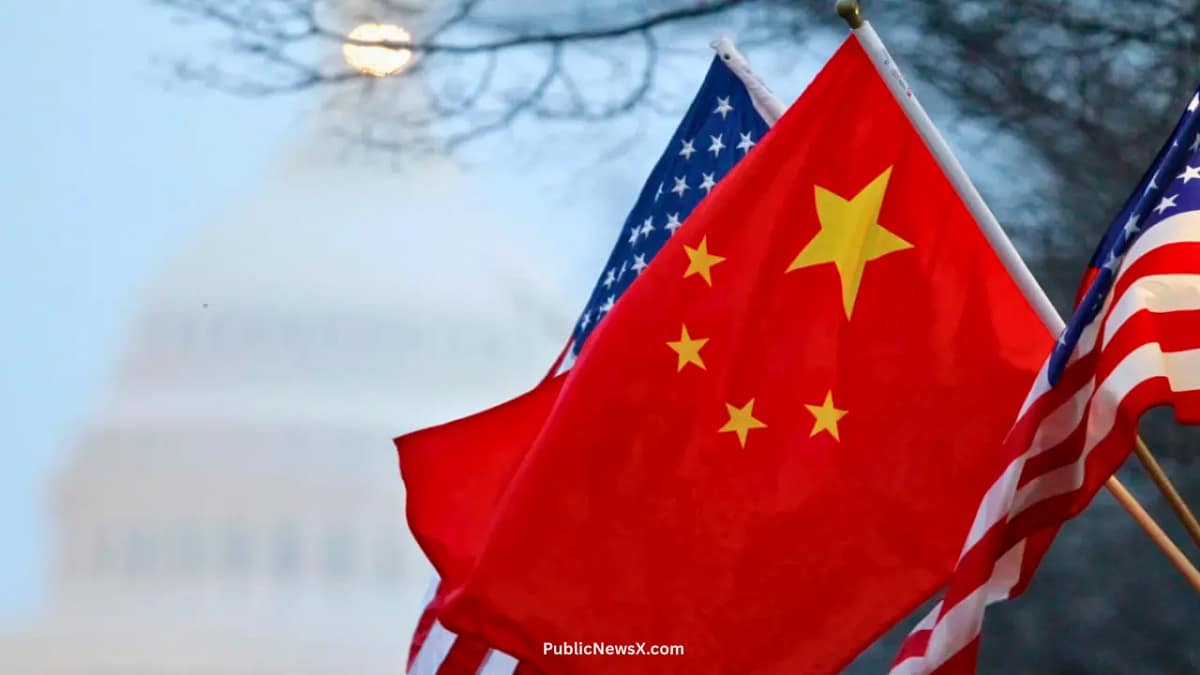
Beijing/ New Delhi: China has flatly rejected the United States’ planned “toughest sanctions in history” on Iran, branding them illegal unilateral measures with no basis in international law or UN Security Council authorisation. Chinese Foreign Ministry spokesperson Lin Jian told reporters in Beijing that sanctions and pressure “will not help resolve the issue,” will only escalate tensions, and urged all parties to pursue political and diplomatic solutions instead.
The sharp rebuff came after US Treasury Secretary Scott Bessent announced Washington would impose the toughest economic isolation campaign ever against Tehran and explicitly urged China to “get with the programme.” President Donald Trump had earlier declared an “Economic D-Day,” warning any country providing Iran a financial or commercial lifeline including oil purchases, banking channels or shipping would face “tremendous economic consequences.”
The statements land nearly six months into the US-Israel conflict with Iran that began in late February 2026. A US naval blockade of Iranian ports and persistent threats around the Strait of Hormuz have already disrupted global energy flows. Brent crude has hovered near $94 a barrel, while Iranian oil offers to Chinese buyers have tightened sharply, with some cargoes moving from deep discounts to premiums.
India has responded with characteristic caution. Ministry of External Affairs spokesperson Randhir Jaiswal said New Delhi is “closely monitoring developments” in West Asia and stands for a “peaceful resolution through dialogue and diplomacy.” India’s measured line mirrors its long-standing preference for multilateral approaches over unilateral sanctions, even as it navigates deeper strategic ties with the United States.
For India, the stakes are immediate and structural. Nearly 40% of its crude, a majority of its LNG and up to 90% of LPG imports have historically moved through the Strait of Hormuz. The conflict has already driven India’s net oil and gas import bill up more than 43% in value in the first four months of the financial year, largely due to higher prices rather than volumes. Indian refiners have diversified aggressively, ramping up Russian crude (which at times exceeded half of imports), Venezuelan barrels and supplies from outside the Gulf, yet freight, insurance and global benchmark prices continue to bite.
Bilateral trade with Iran has shrunk dramatically from over $17 billion in 2018-19 (dominated by oil) to around $1.63 billion, leaving India with a modest surplus in non-oil goods such as rice, tea, pharmaceuticals and dry fruits. Still, the strategic Chabahar Port project remains a flashpoint. India has invested heavily in the Shahid Beheshti terminal as a gateway to Afghanistan and Central Asia that bypasses Pakistan. Successive US sanctions waivers have expired or been curtailed, forcing New Delhi to hand over day-to-day operations to Iranian entities while seeking safeguards to resume control later. Any intensification of secondary sanctions could further freeze the project and complicate the International North-South Transport Corridor.
China’s defiance highlights a wider contest over the legitimacy of unilateral sanctions. Beijing, which has absorbed the bulk of Iran’s oil exports (often 80-90% of seaborne volumes), has previously deployed its own blocking statute to shield domestic firms. India, which does not recognise unilateral sanctions and has historically sought only UN-mandated measures, finds itself in a familiar balancing act: protecting energy security and connectivity ambitions without jeopardising its expanding partnership with Washington.
The under-covered nuances cut deeper. China’s rejection is not pure solidarity with Tehran; it is transactional self-interest backed by rare-earth leverage that could squeeze US defence supply chains already strained by the Iran conflict, plus ample oil stockpiles and Russian alternatives. For India, the real vulnerability is less direct trade exposure and more the cascading price and insurance effects through Hormuz, the fragility of Chabahar, and the absence of a domestic blocking statute that would give Indian companies clearer legal cover against secondary sanctions — an option China and the EU already possess. As Bessent prepares to unveil details of the new package, New Delhi’s quiet insistence on diplomacy may prove both pragmatic and insufficient if secondary measures expand, forcing sharper choices between strategic autonomy, energy resilience and the US relationship.
Share this content: